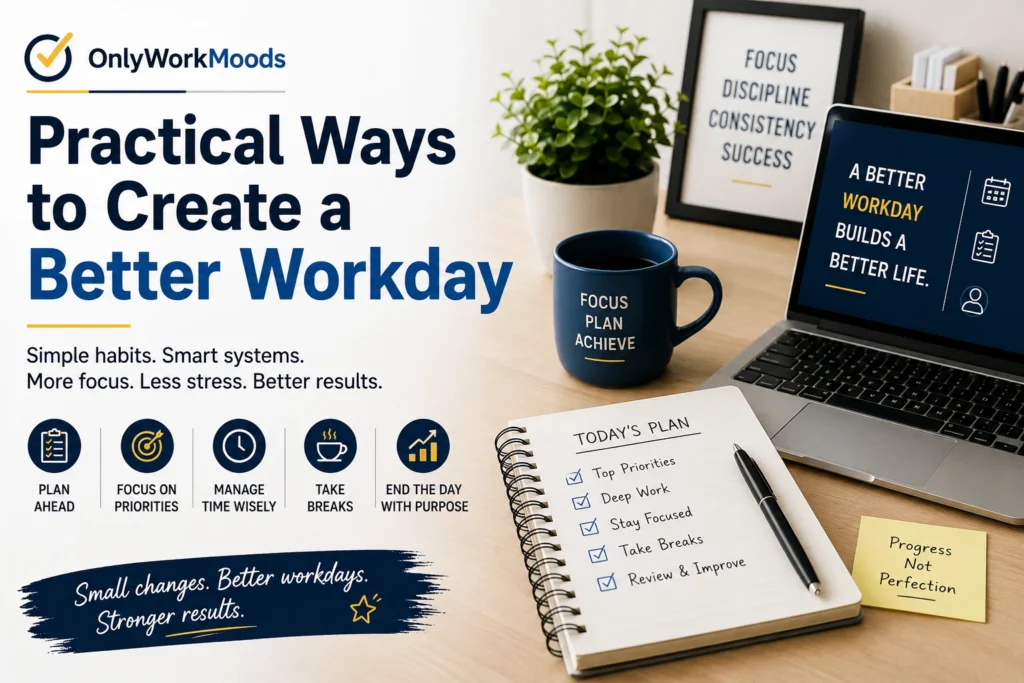
OnlyWorkMoods: Practical Ways to Create a Better Workday.
Introduction
A productive workday isn’t necessarily one where you are busy from morning until evening. It is one where you understand what needs your attention, have a practical way to organize your responsibilities, and can move through your work without creating unnecessary complications.
OnlyWorkMoods focuses on practical ways to make working life more organized, focused, and manageable.
That can mean creating a better start to the day, prioritizing important tasks, reducing distractions, organizing your workspace, communicating more clearly, or developing routines that help you transition between work and personal time.
The goal isn’t to turn every hour into maximum productivity. A sustainable work routine should also leave room for breaks, flexibility, problem-solving, and normal changes in workload.
This guide explores simple strategies you can adapt to different types of work, whether you work in an office, remotely, study, freelance, or manage your own projects.
What Is OnlyWorkMoods?
OnlyWorkMoods is a practical approach to improving the way you organize, approach, and manage your working day.
It focuses on the everyday aspects of work rather than complicated productivity systems.
The approach can include:
- Planning daily responsibilities
- Organizing tasks
- Improving concentration
- Managing workplace distractions
- Creating useful routines
- Keeping a practical workspace
- Communicating effectively
- Protecting personal time
The central idea is simple:
Work should be organized around what actually needs to be accomplished, not around being busy every minute.
1. Start Your Workday With Direction
The first part of the workday can influence how the rest of it feels.
Instead of immediately responding to every message or notification, take a moment to understand what’s ahead.
Check:
- Meetings
- Deadlines
- Important tasks
- Follow-ups
- Time-sensitive responsibilities
Then decide what deserves your attention first.
This doesn’t need to take more than a few minutes.
2. Choose Your Most Important Task
A long task list can make it difficult to know where to begin.
Choose one important task that would make meaningful progress toward your work goals.
Ask:
“If I complete only one important thing during this period, what should it be?”
That answer can become your starting point.
You can handle smaller tasks afterward.
3. Separate Important Tasks From Small Tasks
Not every task deserves the same amount of attention.
High-priority tasks
Work that has significant consequences or deadlines.
Routine tasks
Activities that need to be completed but require less planning.
Optional tasks
Useful activities that can wait when your workload is high.
This simple separation can prevent low-value tasks from taking over your day.
OnlyWorkMoods and Task Organization
Good organization doesn’t need to involve a complicated productivity system.
4. Keep One Main Task List
If your tasks are scattered across emails, notebooks, messages, sticky notes, and multiple apps, it can become difficult to know what is outstanding.
Where practical, keep one primary list.
It could include:
- Today’s tasks
- Upcoming tasks
- Waiting items
- Longer-term projects
The specific tool doesn’t matter.
Consistency does.
5. Break Large Projects Into Smaller Actions
“Complete project” isn’t always a useful next action.
Break it down.
For example:
Large task: Prepare a client report.
Smaller actions:
- Gather information.
- Review the previous report.
- Organize the data.
- Draft the main sections.
- Review the final document.
Smaller actions make progress easier to see.
6. Use Clear Task Descriptions
Vague tasks can be difficult to start.
Compare:
“Marketing work”
with:
“Review the campaign performance report and identify three areas that need attention.”
The second task gives you a clearer starting point.
When writing tasks, make the next action as specific as practical.
7. Review Your List Before Adding More
A common mistake is continually adding new tasks without reviewing existing ones.
Regularly ask:
- Is this still necessary?
- Is it still a priority?
- Can it be completed later?
- Can it be combined with another task?
- Does someone else need to handle it?
Removing unnecessary tasks can be as useful as completing additional ones.
OnlyWorkMoods and Focus
Focused work requires protecting your attention.
8. Identify Your Biggest Distractions
Distractions are different for everyone.
Common examples can include:
- Phone notifications
- Social media
- Unnecessary meetings
- Frequent messaging
- Workplace interruptions
- Open browser tabs
Don’t try to eliminate everything.
Identify the distraction that affects you most and start there.
9. Create Short Periods of Focus
You don’t necessarily need several hours of uninterrupted concentration.
Try creating a defined period where you focus on one task.
During that time:
- Keep the task visible.
- Close unrelated tabs.
- Silence nonessential notifications.
- Avoid switching tasks unnecessarily.
When the period ends, review your progress.
10. Reduce Task Switching
Moving repeatedly between unrelated tasks can make work feel fragmented.
For example, switching between:
Email → Report → Social media → Spreadsheet → Chat → Report
can make it harder to maintain concentration.
Where your job allows, group similar tasks together.
For example:
- Email and messages together
- Administrative work together
- Analysis together
- Writing together
11. Make Your Workspace Support Your Work
Your workspace doesn’t need to be minimalist.
It simply needs to help you work.
Keep frequently used items accessible.
Remove unnecessary clutter from the area where you need to concentrate.
Make sure important documents and tools are easy to find.
The goal is convenience, not visual perfection.
OnlyWorkMoods and Meetings
Meetings can be useful, but they should have a clear purpose.
12. Know Why You’re Attending
Before a meeting, understand:
- What is being discussed?
- What decision is needed?
- What information should you bring?
- What outcome is expected?
If the purpose isn’t clear, clarification can help everyone prepare.
13. Keep Meeting Notes Practical
You don’t need to record every sentence.
Focus on:
- Decisions
- Action items
- Responsibilities
- Deadlines
- Follow-ups
After the meeting, make sure you know what you personally need to do next.
14. Turn Decisions Into Tasks
A meeting may end with:
“We’ll update the report.”
That’s not yet a useful task.
Convert it into something specific:
“Update the report’s performance section by Thursday.”
Clear action items reduce confusion later.
OnlyWorkMoods and Communication
Clear communication can prevent unnecessary back-and-forth.
15. Make Messages Easy to Understand
When sending a work message, consider including:
- Context
- What you need
- Relevant details
- Deadline, if applicable
For example:
“The report is ready for review. Please check the figures in the second section and share any corrections by Thursday.”
The recipient knows what to look at and what action is expected.
16. Don’t Overcomplicate Simple Communication
Not every message requires a long explanation.
For straightforward requests, be direct and polite.
For complex topics, provide enough context for the other person to respond accurately.
The objective is clarity.
17. Confirm Important Decisions
When a decision affects multiple people or a project, summarize it in writing where appropriate.
For example:
Decision: Use the revised campaign schedule.
Next step: The team will update the relevant materials.
Owner: Assigned team member.
Deadline: Agreed date.
This creates a useful reference point.
OnlyWorkMoods and Workday Energy
Productivity isn’t only about managing tasks.
Your ability to work also changes throughout the day.
18. Match Difficult Work With Your Strongest Periods
If possible, schedule demanding work during periods when you tend to concentrate best.
For some people, this might be earlier in the day.
For others, it may be later.
There is no universal schedule.
Pay attention to your own working pattern.
19. Take Reasonable Breaks
Breaks can help create separation between periods of focused work.
A short break could involve:
- Standing up
- Walking
- Getting water
- Stretching
- Looking away from the screen
- Having a brief conversation
The purpose is to step away before returning to the next task.
20. Don’t Treat Every Slow Period as Failure
Some tasks require more thought than others.
Problem-solving, writing, analysis, learning, and creative work may not produce visible results immediately.
A slower period doesn’t automatically mean you’re being unproductive.
Focus on meaningful progress rather than constant activity.
OnlyWorkMoods for Remote and Flexible Work
Working remotely can provide flexibility, but it can also blur the boundary between work and personal time.
21. Create a Clear Work Area
If possible, designate a particular area for work.
It doesn’t need to be a separate room.
Even a specific desk or table can help establish a visual distinction between work and other activities.
22. Establish a Start and Stop Signal
Create a simple routine that marks the beginning of work.
For example:
Start: Set up your workspace and review priorities.
Finish: Save files, update your task list, and close work applications.
These actions can create a clearer transition.
23. Avoid Carrying Every Unfinished Task Into Your Evening
Before finishing, write down anything that remains unfinished.
For example:
- Follow up with someone
- Review document
- Continue analysis
- Prepare tomorrow’s meeting
Once it’s recorded, you don’t have to repeatedly remind yourself.
OnlyWorkMoods and Career Development
A good work routine should support long-term growth too.
24. Keep Track of Skills You’re Developing
Think about what you are learning through your work.
You may be improving:
- Communication
- Analysis
- Leadership
- Writing
- Technology skills
- Project management
- Industry knowledge
Keep notes about useful experiences and lessons.
They can become valuable when reviewing your professional development.
25. Ask for Useful Feedback
Instead of simply asking:
“How am I doing?”
try asking a specific question.
For example:
- “What could I improve in this report?”
- “Was the presentation clear?”
- “What would make this process easier for the team?”
- “Which skill should I strengthen next?”
Specific questions usually make feedback more actionable.
26. Learn From Completed Projects
When a project finishes, spend a few minutes reviewing it.
Ask:
What worked?
Keep it.
What caused delays?
Identify the issue.
What would I change?
Record the lesson.
What can I reuse?
Save useful templates, checklists, or processes.
This turns completed work into future knowledge.
A Practical OnlyWorkMoods Workday Framework
| Workday stage | Simple action |
|---|---|
| Start | Review commitments and priorities |
| Plan | Choose important tasks |
| Focus | Work on one meaningful task |
| Communicate | Handle necessary messages and meetings |
| Reset | Take reasonable breaks |
| Review | Check progress |
| Finish | Record unfinished work and prepare for next time |
You can adapt this framework to different roles and schedules.
Common OnlyWorkMoods Mistakes to Avoid
Trying to be busy all day
Activity isn’t automatically meaningful progress.
Creating an enormous task list
A shorter list can make priorities clearer.
Checking messages constantly
Frequent interruptions can fragment attention.
Making every task urgent
If everything is urgent, priorities become difficult to distinguish.
Over-planning
Planning should help you work, not replace the work itself.
Ignoring breaks
Continuous work isn’t necessarily sustainable.
Taking unfinished work mentally into personal time
Write down the next action so you don’t have to keep remembering it.
A 20-Minute OnlyWorkMoods Workday Reset
If your workday feels disorganized, try this quick reset.
Minutes 1–4: Clear your workspace
Remove unnecessary items and organize the materials you need.
Minutes 5–7: Review your task list
Delete or postpone tasks that aren’t currently important.
Minutes 8–10: Choose your top priority
Identify the task that deserves focused attention.
Minutes 11–14: Remove distractions
Close unnecessary tabs and reduce nonessential notifications.
Minutes 15–17: Check your calendar
Review meetings and deadlines.
Minutes 18–20: Define your next action
Write down exactly what you’ll do next.
Frequently Asked Questions About OnlyWorkMoods
What is OnlyWorkMoods?
OnlyWorkMoods is a practical approach to creating more organized, focused, and manageable workdays. It covers task planning, concentration, communication, workspace organization, routines, and professional development.
How can OnlyWorkMoods improve productivity?
OnlyWorkMoods can improve productivity by helping you prioritize meaningful work and reduce unnecessary distractions. Simple task lists, focused work periods, clear communication, and realistic planning can make daily responsibilities easier to manage.
How should I start my workday?
Start by reviewing your commitments and identifying the most important tasks. Then choose a clear first action instead of immediately reacting to every message or notification.
How can I stay focused at work?
Reduce the distractions that interrupt you most and create defined periods for focused work. Keeping unrelated applications and notifications out of the way can make it easier to concentrate.
How can I avoid feeling overwhelmed by my workload?
Separate important responsibilities from tasks that can wait. Break large projects into smaller actions and focus on the next meaningful step rather than trying to solve everything at once.
How can I end my workday effectively?
Review what you completed, record unfinished tasks, and identify the next action for the following work period. This creates a clear stopping point and reduces the need to remember unfinished work later.
Conclusion
OnlyWorkMoods is about creating a work routine that helps you accomplish meaningful things without unnecessary complexity.
Start by understanding what needs your attention.
Create a manageable task system, prioritize important work, reduce avoidable distractions, communicate clearly, and organize your workspace around the work you actually do.
Remember that productivity isn’t about being occupied every minute.
A strong workday includes focus, flexibility, communication, breaks, learning, and a clear stopping point.
You don’t need to adopt a complicated productivity system.
Choose one part of your workday that regularly feels difficult and improve it.
One practical change today can become a better working habit tomorrow.