
I Am a GenZ Man. Are Nivea Body Lotions Better Than Vaseline for Dry Skin?
Introduction
If you are a Gen Z man trying to build a simple skincare routine, body lotion probably isn’t the first thing you think about.
You may spend more time choosing a face wash, sunscreen, cleanser, or hair product while completely ignoring your arms, legs, elbows, knees, and feet. Then winter arrives, you take a hot shower, and suddenly your skin feels tight, rough, flaky, or uncomfortable.
That is when the familiar NIVEA versus Vaseline question appears.
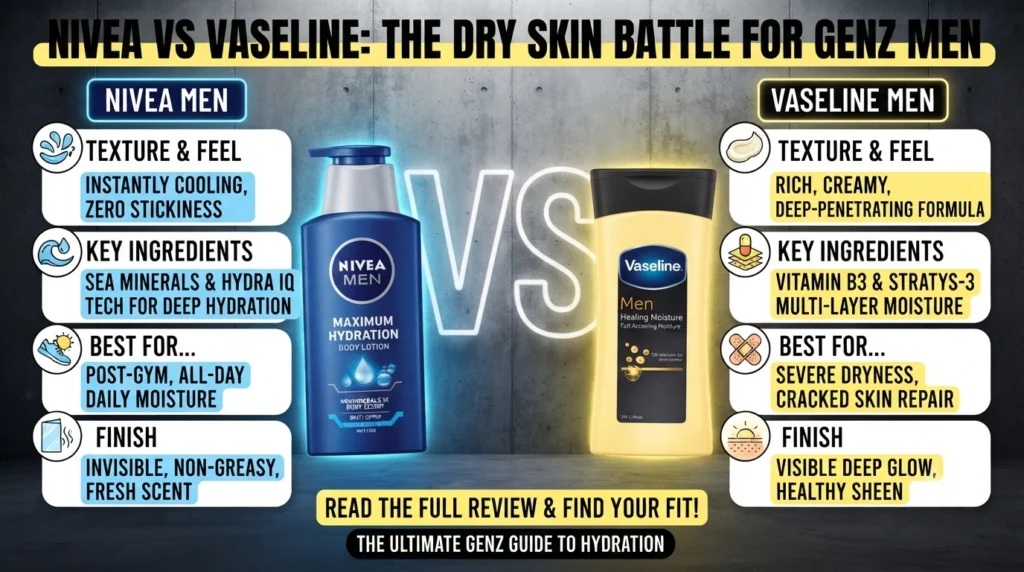
Both brands have a large range of body-care products, but comparing the two by brand name alone doesn’t tell you which option will work better for your particular skin. NIVEA has lotions designed for different levels of dryness, including a current fragrance-free Repair & Care formula with glycerin and panthenol. Vaseline offers both body lotions and petroleum-jelly products, with some lotions combining glycerin and petroleum jelly.
So rather than asking “Is NIVEA better than Vaseline?”, it makes more sense to ask:
What does my skin actually need from a moisturizer?
Dry Skin Is Not Just About Looking Flaky
A common misconception is that you only need body lotion when you can visibly see flakes.
Dry skin can show up in several ways.
You might notice:
- Tightness after showering
- Rough patches
- Ashy-looking skin
- Mild itching
- Flaking
- Cracking around heels
- Rough elbows and knees
- Skin that feels uncomfortable after cleansing
The American Academy of Dermatology recommends moisturizing dry skin regularly and applying moisturizer while the skin is still damp after bathing.
That means your body-care routine shouldn’t necessarily begin when your skin starts looking damaged.
Regular moisturizing can be part of maintaining comfortable skin.
The Real Difference: Lotion vs Moisture Locking
One useful way to understand NIVEA and Vaseline is to stop thinking about the brands and look at what different products are designed to do.
A moisturizer can contain several types of ingredients.
Humectants
Humectants help attract and hold water.
Glycerin is one of the most common examples.
NIVEA currently uses glycerin in several body-care formulas, including its Repair & Care Fragrance-Free Body Lotion.
Emollients
Emollients help soften and smooth the skin.
They can improve how rough or dry skin feels.
Occlusives
Occlusives help reduce water loss from the skin.
Petrolatum, commonly known as petroleum jelly, is a well-known occlusive.
This is why petroleum-jelly-based products can be particularly useful when the main problem is moisture escaping from very dry skin.
The AAD lists ingredients including glycerin, hyaluronic acid, mineral oil, petrolatum and shea butter among ingredients that can be useful in moisturizers for dry skin.
Why NIVEA Can Be Attractive for Everyday Body Care
Imagine your morning routine.
You shower, get dressed, put on deodorant, fix your hair, and leave.
You probably don’t want your body moisturizer to become a 15-minute project.
A traditional body lotion can make sense in this situation because it is designed to cover larger areas of the body.
NIVEA currently offers several body moisturizers for dry skin, including lightweight and richer formulas. Its Repair & Care Fragrance-Free Body Lotion is marketed for dry and sensitive skin and contains 10% glycerin and panthenol. NIVEA reports 72-hour moisturization based on an instrumental test involving 33 participants.
That particular result is a brand-reported product claim, not proof that every NIVEA lotion provides the same result.
This distinction matters.
When comparing products, check the individual formula instead of assuming everything from one brand works identically.
Why Vaseline Can Be Useful When Skin Loses Too Much Moisture
Vaseline is particularly associated with petroleum jelly, but the brand also sells many body lotions.
Its current Indian range includes lotions and moisturizers aimed at dry and very dry skin, along with formulas featuring ingredients such as glycerin, hyaluronic acid, cocoa butter, aloe vera and petroleum jelly.
Vaseline’s own dry-skin guidance highlights the combination of glycerin and petroleum jelly in some Advanced Repair products. According to the brand, glycerin helps attract moisture while micro-droplets of petroleum jelly help lock it in.
That combination illustrates an important skincare concept:
Adding moisture and reducing moisture loss are two related but different jobs.
For extremely dry areas, a more occlusive product may therefore be useful.
What Should a Gen Z Man Look for on the Ingredient Label?
Instead of choosing a product because TikTok, Instagram, or a friend recommends it, learn a few ingredients.
You don’t need to become a cosmetic chemist.
Start with these.
Glycerin
Useful for attracting and retaining water.
Hyaluronic Acid
A humectant commonly used in moisturizing products.
Petrolatum
A strong occlusive that helps reduce water loss.
Panthenol
Also known as provitamin B5, it is used in skincare formulations and can contribute to moisturizing and soothing properties.
Ceramides
Lipids associated with the skin barrier and commonly used in products formulated for dry or compromised skin.
Shea Butter
An emollient-rich ingredient used in many moisturizing products.
The key is not to search for one magical ingredient.
A well-formulated moisturizer can combine several types of ingredients.
What If You Hate Sticky Lotion?
This is a surprisingly important question.
Let’s say you buy an extremely rich moisturizer because your skin is dry.
But you hate how it feels.
You apply it twice.
Then it stays untouched for the next three months.
Technically, you bought a moisturizer.
Practically, you don’t have a moisturizing routine.
The AAD emphasizes that there isn’t a single moisturizer that suits everyone. Different people may prefer lotions, creams, or ointments depending on their skin and needs.
Therefore, texture is not merely a cosmetic preference.
It can influence whether you use the product consistently.
If You Have Sensitive Skin, Read the Fragrance Label
Gen Z skincare often focuses on attractive packaging, pleasant smells, and “fresh” sensations.
Dry or sensitive skin can have different priorities.
The AAD recommends gentle, fragrance-free skincare products for people with dry skin because fragrance can irritate dry, sensitive skin.
NIVEA currently offers a fragrance-free Repair & Care body lotion specifically positioned for dry and sensitive skin.
That doesn’t mean every fragranced product will cause problems for every person.
It means that if your skin is already sensitive, fragrance-free is a useful feature to look for.
Your Body Lotion Routine Should Be Simple
You don’t need a complicated men’s body-care routine.
Try this basic sequence.
Step 1: Shower
Use lukewarm rather than extremely hot water.
Step 2: Cleanse
Use a gentle cleanser or body wash, especially if your skin becomes dry easily.
Step 3: Pat Dry
Don’t aggressively rub your skin with a towel.
Step 4: Moisturize
Apply your body moisturizer while your skin is still slightly damp.
Step 5: Target Dry Areas
Give extra attention to elbows, knees, hands, ankles and heels if they tend to become rough.
NIVEA recommends applying moisturizer when the skin is still slightly damp, while the AAD similarly recommends moisturizing immediately after bathing.
Why Shower Temperature Matters
You could have a great moisturizer and still make dry skin worse through your shower habits.
Long, very hot showers can strip oils from the skin.
The AAD recommends warm or lukewarm water and keeping showers relatively short for people dealing with dry or sensitive skin.
So if your routine looks like:
Very hot shower → harsh body wash → aggressive towel drying → no moisturizer
switching from NIVEA to Vaseline probably isn’t going to solve the entire problem.
Your routine itself needs attention.
NIVEA vs Vaseline After the Gym
For Gen Z men who train regularly, body care can become slightly more complicated.
You sweat.
You shower frequently.
You may use body wash every day.
You may also spend time outdoors.
If your skin starts feeling tight after your post-workout shower, moisturizer can become a useful part of your routine.
A simple gym-day routine could be:
Workout → shower → pat dry → body lotion → clean clothes.
You don’t need a separate “gym moisturizer” unless you have a particular skin concern.
The goal is consistency.
What About Summer?
Summer can change your preference.
Heavy products can feel uncomfortable when temperatures are high.
You may prefer a lighter lotion that spreads quickly.
At the same time, sweating does not mean your skin automatically has enough moisture.
If your skin still feels tight after showering, moisturization may be worthwhile.
NIVEA’s current dry-skin guidance includes both richer and lightweight moisturizing options, illustrating that texture can be selected according to personal preference and skin condition.
Vaseline’s current range similarly includes multiple body lotions rather than relying solely on petroleum jelly.
What About Winter?
Winter can be a completely different situation.
Cold and dry environmental conditions can make skin feel rougher and tighter.
You may notice your:
- Hands cracking
- Legs becoming flaky
- Elbows becoming rough
- Heels becoming harder
- Skin feeling tight after bathing
During these periods, a richer cream or ointment may be preferable to a lightweight lotion.
The AAD notes that creams and ointments generally provide more moisture than lotions and may be better suited to very dry skin.
This is another reason your preferred moisturizer can change throughout the year.
Can You Use NIVEA and Vaseline Together?
You don’t necessarily have to choose one brand exclusively.
For example, you could use a regular body lotion over most of your body and a petroleum-jelly-based product on specific areas that become exceptionally dry.
A simple approach might be:
Body lotion → elbows → heels → hands
with petroleum jelly reserved for the driest spots.
The AAD recognizes petrolatum as an ingredient that can help with dry skin and recommends creams or ointments when skin needs more intensive moisturization.
You don’t need to cover your entire body in petroleum jelly if you don’t like the texture.
Is More Moisturizer Always Better?
Not necessarily.
The goal isn’t to create the thickest possible layer.
The goal is to use enough product to keep your skin comfortable.
If your skin is only mildly dry, a lighter lotion may be perfectly practical.
If your skin is very dry, a cream or ointment may be more appropriate.
If you repeatedly need heavier products and still experience cracking, bleeding, severe itching, redness, or persistent irritation, it may be time to speak with a dermatologist rather than continuously changing moisturizers. The AAD recommends professional evaluation when severe dryness becomes painful, cracked, bleeding, or very irritating.
A Practical Decision Table
| Situation | What may make sense |
|---|---|
| Mild everyday dryness | Lightweight body lotion |
| Dry skin after shower | Lotion on damp skin |
| Very rough elbows | Rich cream or occlusive |
| Cracked heels | Thick cream or petroleum jelly |
| Sensitive skin | Fragrance-free moisturizer |
| Hot weather | Lightweight texture |
| Cold weather | Richer moisturizer |
| Gym every day | Easy-to-use daily lotion |
| Extremely dry skin | Cream or ointment |
| Persistent irritation | Dermatologist evaluation |
This isn’t a ranking of brands. It is a way to match the type of product with the problem you’re trying to solve.
NIVEA vs Vaseline: What Should You Actually Compare?
If you’re standing in a store looking at two bottles, don’t immediately compare the logos.
Compare these things instead:
1. Skin concern
Is your skin mildly dry or extremely dry?
2. Formula
Look at the ingredient list.
3. Texture
Will you actually enjoy using it?
4. Fragrance
If your skin is sensitive, consider fragrance-free options.
5. Application
Can you comfortably use it every day?
6. Climate
Do you live somewhere hot and humid or cold and dry?
7. Body area
Your elbows may need something different from your arms.
This method gives you a much more useful comparison than simply asking whether NIVEA or Vaseline is “better.”
NIVEA or Vaseline: Which One Fits Different Users?
The minimalist
If you want one easy product for everyday body care, look for a lotion with a comfortable texture that you will actually use consistently.
The very dry-skin user
Consider a richer cream or ointment, particularly for rough areas. The AAD generally favors creams and ointments over lotions for very dry skin.
The fragrance-sensitive user
Prioritize fragrance-free options.
The gym-focused user
Choose something that fits naturally into your post-shower routine.
The winter-dry user
Consider moving toward a richer formula when the weather becomes colder and drier.
The person who hates greasy products
Start with a lighter lotion rather than forcing yourself to use a heavy ointment everywhere.
Common Body-Lotion Mistakes to Avoid
Waiting until your skin cracks
Moisturizing doesn’t have to be an emergency response.
Applying lotion hours after showering
Moisturizing soon after bathing is generally more useful because damp skin helps retain water.
Using extremely hot water
This can worsen dryness.
Scrubbing flakes aggressively
Dry, peeling skin doesn’t automatically mean you need stronger exfoliation. The AAD specifically cautions against exfoliating dry, peeling skin because it can strip additional moisture.
Choosing based only on fragrance
A nice smell doesn’t necessarily mean a product is appropriate for sensitive skin.
Assuming every NIVEA product is identical
It isn’t.
Assuming every Vaseline product is petroleum jelly
It isn’t.
Both brands have multiple product categories.
FAQs
Is NIVEA better than Vaseline for men’s dry skin?
There isn’t one universal answer. Both brands offer different formulations, and the appropriate choice depends on your skin’s dryness, sensitivity, preferred texture and the specific product you’re considering.
Is Vaseline good for extremely dry skin?
Petroleum jelly can be useful for reducing moisture loss, while Vaseline also sells lotions formulated for dry and very dry skin. The brand currently describes glycerin and petroleum jelly as key ingredients in some of its Advanced Repair products.
Which is better for sensitive skin: NIVEA or Vaseline?
Rather than choosing based on the brand, look for a fragrance-free formula that your skin tolerates. The AAD recommends fragrance-free products for dry, sensitive skin.
Should men apply body lotion every day?
If your skin tends to be dry, daily moisturizing can be a useful habit. The AAD recommends moisturizing regularly and applying moisturizer when skin is still damp after bathing.
Should I apply NIVEA or Vaseline after showering?
Either can be used depending on the product and your skin’s needs. Applying moisturizer shortly after showering while the skin remains slightly damp is a commonly recommended approach.
Can I use Vaseline petroleum jelly over body lotion?
Yes. Using a moisturizing lotion first and petroleum jelly on selected very dry areas can be a practical approach when you want both moisturization and an occlusive layer.
Is body lotion necessary if I drink lots of water?
Drinking adequate fluids is important for overall health, but dry skin is also affected by environmental conditions, bathing habits and the skin barrier. Topical moisturization can therefore still be useful when your skin is dry.
When should I stop experimenting with body lotions?
If dryness becomes persistent, painful, cracked, bleeding, severely itchy, or associated with significant redness or a rash, consider seeing a dermatologist rather than continually changing products.
Final Thoughts
For a Gen Z man, choosing between NIVEA and Vaseline doesn’t need to become a complicated skincare debate.
Start with your actual problem.
If you need a comfortable everyday body lotion, look for a formula that spreads easily and fits your routine. If your skin is losing a lot of moisture, an occlusive ingredient such as petrolatum may become more important. If your skin is sensitive, fragrance-free products deserve extra attention.
The most useful routine is usually the one you can maintain.
Shower gently. Keep the water comfortably warm. Pat your skin dry. Moisturize while it is still damp. Give extra attention to areas that become rough.
And remember that NIVEA and Vaseline aren’t single products. Their ranges contain different formulations, so compare the actual ingredients and intended use rather than assuming one brand automatically works better.
Your skin doesn’t care which logo is on the bottle.
It cares about whether the product suits its needs.