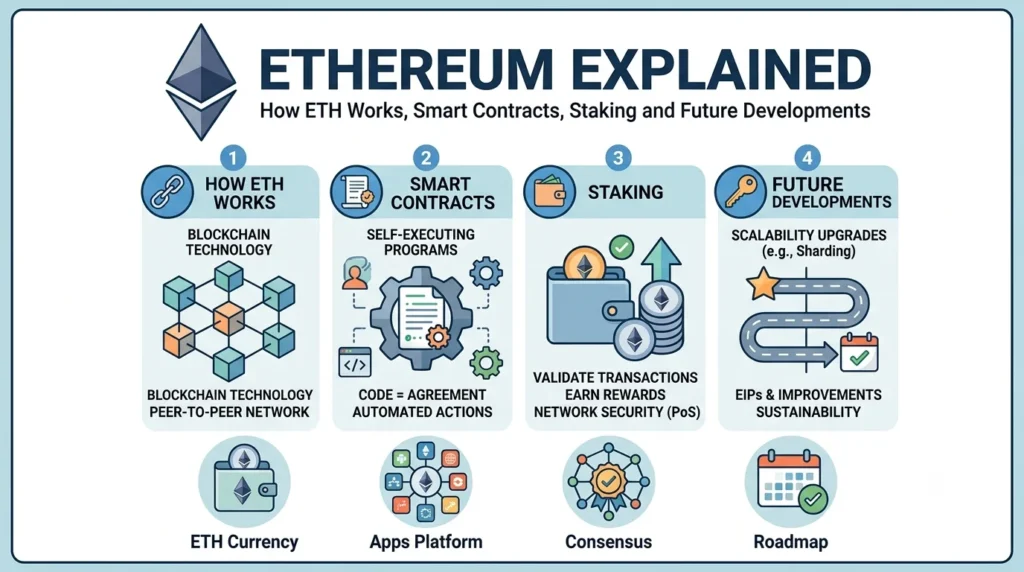
Ethereum Explained: How ETH Works, Smart Contracts, Staking and Future Developments.
Introduction
Ethereum is one of the best-known blockchain networks, but its purpose extends beyond sending and receiving digital currency. The platform allows developers to build applications, create digital assets, automate agreements and develop financial services using blockchain technology.
Its native cryptocurrency, Ether (ETH), plays an important role in this ecosystem. Users can spend ETH on transaction fees, participate in network staking and interact with applications built on Ethereum. However, the blockchain network and its cryptocurrency serve different purposes.
To understand Ethereum, it helps to explore how its blockchain operates, what smart contracts do and why transaction fees exist. Its proof-of-stake system, practical applications and potential security risks are also important considerations.
This guide explains Ethereum in straightforward language, explores its major uses and discusses developments on its official roadmap.
Quick Answer: What Is Ethereum?
| Question | Answer |
|---|---|
| What is Ethereum? | A decentralised blockchain platform that supports transactions and programmable applications. |
| What is ETH? | Ether, the native cryptocurrency of the Ethereum network. |
| What is Ethereum used for? | Digital payments, smart contracts, decentralised finance, digital assets and blockchain applications. |
| What are smart contracts? | Programs that execute according to predefined rules on a blockchain. |
| Does Ethereum use mining? | No. Ethereum uses proof of stake to reach consensus. |
| Do Ethereum transactions have fees? | Yes. Transactions on the main network generally require gas fees paid in ETH. |
| Can ETH lose value? | Yes. Its market price can fluctuate significantly. |
| Is Ethereum risk-free? | No. Market, application, wallet and security risks remain. |
1. What Is Ethereum?
Ethereum is a blockchain network that allows people to transfer digital assets and interact with software applications running on a shared, decentralised system.
Unlike a traditional database controlled by one organisation, Ethereum relies on a distributed network of computers to maintain and verify its records. Participants follow the network’s protocol to agree on transaction history and the current state of accounts and smart contracts.
The project was proposed by Vitalik Buterin in 2013, and the Ethereum network launched in 2015. Its development introduced a general-purpose platform for blockchain applications rather than focusing exclusively on digital currency transfers.
Why Was Ethereum Created?
Bitcoin demonstrated that a blockchain could support peer-to-peer digital payments without a central payment processor. Ethereum expanded on this concept by introducing a programmable environment for executing code on a blockchain.
Developers can use that capability to create applications with rules enforced by the network. Depending on the application, these rules may manage token transfers, lending arrangements, digital collectibles or other operations.
Although Ethereum can reduce the need for certain intermediaries, it does not eliminate every middleman or guarantee that all applications are trustworthy. Instead, the network provides infrastructure for building systems with different levels of decentralisation and automation.
Who Controls Ethereum?
Ethereum does not operate like a conventional company-owned platform with one central administrator controlling every transaction.
Its development involves researchers, software developers, node operators, validators and community participants. Changes to the network require coordination and adoption by relevant participants rather than a single organisation simply changing a central database.
The Ethereum Foundation supports parts of the ecosystem, but the organisation is not the same thing as the Ethereum network itself.
2. How Does Ethereum Work?
Ethereum combines blockchain records, network participants, cryptography and a system for executing transactions and smart contracts. Four important components help explain how the system operates.
The Blockchain
The blockchain records transactions and the results of activity on the network. Transactions are grouped into blocks, which become part of the chain according to Ethereum’s consensus rules.
Because many independent participants verify and maintain the network, altering accepted history is designed to be difficult and costly.
Nodes
Nodes are computers running Ethereum software. Depending on their configuration, they can verify blockchain data, communicate with other participants and help users or applications access the network.
Running a node is different from running a validator. A node can verify the chain without necessarily staking ETH or proposing blocks.
Validators
Ethereum uses proof of stake. Validators commit ETH to participate in the consensus process, helping the network determine which blocks are accepted.
Protocol rules govern their activities, and dishonest behaviour can result in penalties. In applicable circumstances, validators may lose some of their staked ETH.
The Ethereum Virtual Machine
The Ethereum Virtual Machine (EVM) is the execution environment for Ethereum smart contracts. It processes contract instructions and calculates the resulting changes to the blockchain’s state.
For example, a decentralised exchange may use smart contracts to calculate a token swap and update the relevant balances. Ethereum processes the contract according to its code and the network’s execution rules.
3. Ethereum vs ETH: What Is the Difference?
Ethereum and ETH are related, but they refer to different things.
Ethereum is the blockchain network and programmable platform. ETH, also called Ether, is its native cryptocurrency.
ETH has several roles within the ecosystem:
- Paying transaction fees on Ethereum.
- Transferring value between accounts.
- Providing the asset used for native network staking.
- Interacting with decentralised applications and digital asset services.
For instance, someone may use a decentralised finance application built on Ethereum. Smart contracts power the application’s operations, while ETH may be required to pay the network fee.
Not every Ethereum-based application requires users to hold ETH for every interaction. Some applications and scaling networks offer different fee arrangements or sponsor transaction costs. The details depend on the product and network being used.
Other tokens created on Ethereum should also be distinguished from native ETH. A token may represent a digital asset, a governance right or another function, but that does not make it the same as Ether.
4. What Are Smart Contracts?
Smart contracts are programs deployed to a blockchain. They execute according to their programmed logic when users or other contracts interact with them.
Unlike a conventional agreement that depends entirely on a person processing every step, a smart contract can automatically carry out specified actions. Its behaviour, however, depends on the quality of the code, the data it receives and the conditions built into the application.
Examples of Smart Contracts
Token transfers: A contract can define how a digital token is issued, transferred or managed.
Decentralised finance: Smart contracts can support lending, borrowing, trading and liquidity arrangements without requiring every operation to be processed by a traditional financial institution.
Digital collectibles: Non-fungible tokens (NFTs) can use smart contracts to record token ownership and implement particular transfer rules.
Decentralised organisations: Some groups use contracts to manage voting, treasury operations and governance processes.
Are Smart Contracts Always Safe?
No. A contract can contain coding errors, security weaknesses or economic design flaws. Once deployed, correcting an issue may be difficult, depending on how the application was built.
Some contracts also rely on external data services known as oracles. If an oracle supplies incorrect or manipulated information, the application may produce an unwanted result.
Before committing funds, users should examine an application’s reputation, security documentation, audit information and permissions. An audit can help identify weaknesses, but it cannot guarantee that a contract is completely secure.
5. What Is Ethereum Used For?
Ethereum supports a wide range of applications. Their purposes vary according to the developers, services and users participating in the ecosystem.
Decentralised Finance (DeFi)
Decentralised finance applications use blockchain-based software to offer services such as token swaps, lending, borrowing and liquidity provision.
Some users prefer these systems because transactions can be handled through publicly accessible smart contracts. Nevertheless, DeFi products can expose participants to smart contract exploits, volatile collateral values, liquidation and liquidity problems.
Digital Assets and NFTs
Ethereum supports tokens that represent digital assets and other forms of blockchain-based ownership. NFTs, for example, use unique token identifiers to distinguish individual tokens within a collection or application.
Owning an NFT does not automatically mean owning copyright to the associated artwork or media. Those rights depend on the applicable terms and legal arrangements.
Stablecoins and Payments
Many stablecoins and other digital tokens operate on Ethereum. Depending on the asset and service, people may use them for transfers, trading or other financial activities.
A stablecoin’s intended price stability is not an absolute guarantee. Potential risks include the issuer, reserve arrangements, redemption mechanisms and the smart contracts or platforms involved.
Gaming and Digital Communities
Blockchain applications can use Ethereum-compatible infrastructure to manage digital items, token-based rewards and community participation. Some games use Ethereum or related scaling networks to record particular activities or assets.
The presence of a token does not necessarily make a game profitable or valuable. Users should consider the actual gameplay, fees, token economics and risks before spending money.
Decentralised Applications
Ethereum supports applications that interact with blockchain data and smart contracts. These may cover identity-related tools, infrastructure, marketplaces and other services.
However, the level of decentralisation varies. An application can use Ethereum for settlement while still relying on centralised websites, servers, administrators or data providers.
6. Understanding Ethereum Gas Fees
Gas is the unit used to measure the computational work required to process operations on Ethereum.
A simple ETH transfer generally requires less computation than a complex smart contract interaction. Consequently, transactions can have different gas requirements.
The fee depends on the amount of gas used and the applicable gas price. Network demand also influences the price users may need to pay for timely processing.
Why Do Gas Fees Change?
Ethereum fees can rise when many users compete to have transactions processed. A popular token launch or a period of heavy decentralised finance activity may increase demand for block space.
When demand falls, transaction fees may become lower. However, costs can change quickly, so a price observed earlier may not reflect the amount required when a transaction is submitted.
How Can You Manage Gas Costs?
Consider these practical steps:
- Check the estimated fee: Review the transaction estimate in your wallet before approving it.
- Avoid unnecessary transactions: Repeated contract interactions can create additional costs.
- Compare networks carefully: Some applications operate on Ethereum layer 2 networks, which can offer lower transaction costs. Confirm that the application supports the network you intend to use.
- Verify the destination: Sending assets to the wrong address or using an incompatible network can result in loss.
- Understand the full cost: A displayed network fee may not include an exchange’s separate trading, withdrawal or service charges.
Gas fees are not the same as the purchase price of ETH. Instead, they are charges for processing a transaction, and their value can change independently of ETH’s market price.
7. How Ethereum Staking Works
Ethereum’s proof-of-stake system uses validators who commit ETH to participate in network consensus. This mechanism replaced Ethereum’s previous proof-of-work mining system in September 2022.
Staking helps secure the network because validators have economic incentives to follow the protocol. Penalties can apply when validators violate important rules or fail to perform their duties.
What Is Required to Run a Validator?
Operating a standard solo validator requires a deposit of 32 ETH, along with suitable hardware, software, reliable connectivity and ongoing maintenance.
People who do not want to run their own validator may consider third-party staking services or pooled options. These arrangements have different requirements and risks, and they are not equivalent to running an independent validator.
Can You Earn Rewards From Staking?
Validators can receive rewards for participating correctly in consensus. However, the amount varies with network conditions and validator performance.
A displayed reward rate should not be treated as guaranteed income. Service fees, downtime, penalties and the market price of ETH can all affect the financial outcome.
What Are the Risks of Staking?
- Validator penalties: Poor performance or protocol violations can reduce returns or cause losses.
- Provider risk: A third-party service may fail, be compromised or impose restrictive terms.
- Smart contract risk: Some pooled staking products depend on contracts that may contain vulnerabilities.
- Liquidity risk: A staking-related token may trade below the value of the underlying assets.
- Market risk: ETH can lose market value even while staking rewards accumulate.
Before staking, understand who controls the funds, how withdrawals work, what fees apply and whether you can tolerate the potential loss.
8. Ethereum vs Bitcoin
Ethereum and Bitcoin are both important blockchain projects, but they were designed with different priorities.
| Feature | Ethereum | Bitcoin |
|---|---|---|
| Native asset | ETH (Ether) | BTC (Bitcoin) |
| Main focus | Programmable blockchain and applications | Peer-to-peer digital money and value transfer |
| Consensus mechanism | Proof of stake | Proof of work |
| Smart contracts | General-purpose programmable execution | More limited scripting capabilities |
| Common applications | DeFi, tokens, NFTs and decentralised applications | Transfers, savings use cases and other Bitcoin-based applications |
| Transaction fees | Depend on gas use and network demand | Depend on transaction characteristics and network demand |
| Investment risk | High and market-dependent | High and market-dependent |
Neither asset is guaranteed to outperform the other. Their technologies, adoption patterns, monetary designs and market behaviour differ, so investors should evaluate them separately rather than assuming they are interchangeable.
9. Advantages and Limitations of Ethereum
Ethereum’s flexibility has helped it support many types of blockchain applications. Still, its benefits come with trade-offs.
Advantages
Programmability: Developers can create applications that execute defined rules through smart contracts.
Open participation: People can access the public network without obtaining permission from a conventional central operator, although individual services may impose restrictions.
Broad ecosystem: Ethereum has infrastructure for tokens, decentralised finance, wallets, developer tools and scaling networks.
Native staking: ETH holders can participate in network security directly or through third-party arrangements, depending on their requirements and risk tolerance.
Public verification: Blockchain data allows transactions and contract activity to be inspected using suitable tools.
Limitations
Variable fees: Mainnet transaction costs can increase during periods of high demand.
Technical complexity: Wallet management, network selection, signing transactions and understanding contract permissions can be difficult for newcomers.
Security vulnerabilities: Wallets, applications, bridges and smart contracts may be compromised.
Price volatility: ETH’s market price can change substantially in short periods.
Scams and misleading claims: Fraudulent websites and impersonation schemes may target people interested in cryptocurrency.
Scaling trade-offs: Layer 2 networks can improve costs and capacity, but each solution has its own security, usability, decentralisation and bridging considerations.
A balanced understanding of Ethereum means recognising both its technical capabilities and the practical challenges of using it.
10. Ethereum’s Roadmap and Future Development
Ethereum continues to evolve through coordinated protocol upgrades. These changes aim to improve scalability, security, user experience and the network’s ability to support more activity.
One development listed on the official roadmap is Glamsterdam, targeted for the fourth quarter of 2026. Its planned changes include enshrined proposer-builder separation and block-level access lists, which are intended to improve how blocks are assembled, processed and verified.
As of October 2026, the mainnet activation date has not been confirmed in the Ethereum Foundation’s published testnet announcement. Therefore, the roadmap’s timing should be treated as a target rather than a guaranteed release date.
The next upgrade, Hegotá, is listed for 2027, although its scope and schedule may change. Planned work includes mechanisms intended to strengthen transaction inclusion and censorship resistance.
These developments reflect ongoing engineering work rather than promises of guaranteed price increases or immediate improvements for every user. Protocol upgrades can take time to implement, test and adopt.
Will Ethereum Become More Affordable?
Scaling is a major part of Ethereum’s development. Layer 2 networks already provide alternative environments for processing transactions and settling activity using Ethereum-related infrastructure.
Future upgrades may improve capacity and efficiency, but the actual fees users pay will continue to depend on network demand, the application, the chosen layer and the transaction involved.
What Should Users Watch?
Anyone following Ethereum’s development should monitor official release announcements, security disclosures, network upgrades and changes to the applications they use.
For accurate information, consult the official Ethereum roadmap rather than relying on social media predictions. Upgrade dates and planned features can change as testing reveals new requirements.
11. Is Ethereum Safe to Use?
Ethereum’s protocol has extensive engineering and security work behind it, but using Ethereum does not make every transaction or application safe.
Many losses happen because users approve malicious transactions, disclose recovery phrases, visit imitation websites or trust fraudulent investment offers.
Basic Security Practices
- Use a reputable wallet and obtain it through the provider’s verified website or official app store listing.
- Keep your recovery phrase private and offline. Never share it with someone claiming they need it to verify your wallet.
- Check the full destination address before sending assets.
- Read wallet approval requests carefully, especially when a website asks for permission to spend tokens.
- Consider a hardware wallet for larger holdings if you understand how to use and back it up securely.
- Test unfamiliar transfer procedures with a small amount when appropriate.
- Be cautious of guaranteed returns, unsolicited messages and pressure to act quickly.
- Research decentralised applications and staking providers before depositing funds.
Remember that blockchain transactions are generally difficult or impossible to reverse once confirmed. If an error or scam occurs, there may be no central customer service department capable of recovering the assets.
12. How to Get Started With Ethereum
New users can learn about Ethereum without immediately investing significant money.
Step 1: Learn the Basics
Understand the differences between Ethereum, ETH, wallets, tokens, smart contracts and gas fees. These concepts help you assess what a website or application is asking you to do.
Step 2: Choose a Wallet Carefully
A wallet helps you manage keys and interact with blockchain accounts. Review the provider’s reputation, supported networks, backup process and security features before selecting one.
Step 3: Protect Your Recovery Phrase
A recovery phrase may provide control over the wallet’s funds. Store it securely, and never enter it into a website simply because a pop-up or message tells you to do so.
Step 4: Understand the Network
Before sending ETH or tokens, confirm that the sending and receiving services support the same network and asset. A token with a familiar name on a different network may not be interchangeable with the asset you intended to transfer.
Step 5: Start With Low-Risk Learning
Explore official documentation, public blockchain explorers and educational resources. If you decide to transact, understand the fee and the consequences before approving the transaction.
Step 6: Research Before Investing
Do not buy ETH solely because of social media hype or predictions about future prices. Consider your financial circumstances, risk tolerance, investment time horizon and the possibility of losing money.
This information is educational and is not personalised financial advice.
13. Final Thoughts
Ethereum has developed into a programmable blockchain ecosystem that supports far more than cryptocurrency transfers. Its smart contracts provide the foundation for decentralised finance, digital assets and many other applications, while ETH supports transaction fees and the proof-of-stake consensus system.
Understanding these different components makes it easier to evaluate Ethereum’s practical uses and limitations. Network fees, technical complexity, market volatility and application-level security remain important considerations for anyone exploring the ecosystem.
The network’s future will depend on continued development, adoption, security improvements and the ability to scale without compromising its core goals. Anyone interested in Ethereum should follow official documentation, verify claims independently and approach cryptocurrency transactions with care.
What is Ethereum in simple words?
Ethereum is a blockchain platform that records transactions and runs programmable applications. Its native cryptocurrency, ETH, is used for fees, transfers and staking.
Is Ethereum a cryptocurrency or a blockchain?
Ethereum is the blockchain network and software ecosystem. Ether (ETH) is the cryptocurrency associated with that network.
Does Ethereum still use mining?
No. Ethereum switched from proof of work to proof of stake in September 2022. Validators now participate in the consensus process by staking ETH.
How much ETH do I need to stake?
Running a standard solo validator requires 32 ETH. Some third-party and pooled staking services allow participation with smaller amounts, but their terms, costs and risks differ.
Can Ethereum transactions be reversed?
Confirmed blockchain transactions generally cannot be reversed through a central authority. Certain applications may offer their own dispute or recovery processes, but users should not assume that incorrectly transferred funds can be retrieved.