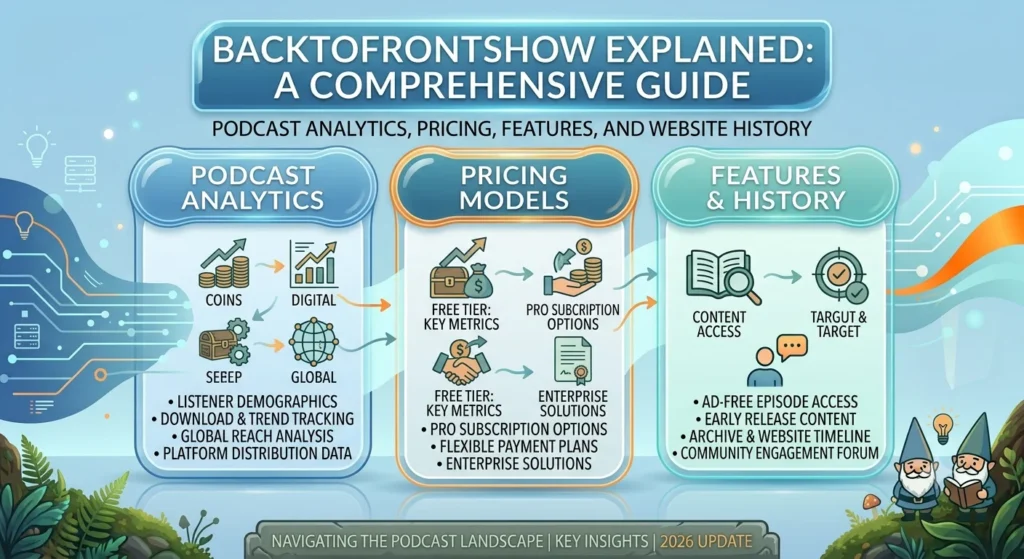
BacktoFrontShow Explained: Podcast Analytics, Pricing, Features and Website History.
Introduction
BacktoFrontShow is a name that can lead to two different types of information online. The current website, BacktoFrontShow.com, presents itself as a podcast analytics platform designed to help creators and media teams understand listener behaviour. However, the domain also contains historical pages associated with The Back to Front Show, an older web and technology podcast.
This distinction matters when researching the website, its features or its pricing. Someone looking for the original podcast may encounter a commercial analytics service instead, while a person researching the analytics platform may come across older episodes and show notes.
The current website advertises audience demographics, listening behaviour, engagement metrics, device analytics and custom reporting. It also displays monthly prices for Basic and Pro plans, with custom pricing for Enterprise. These are details published by the website, so prospective users should verify the product, commercial terms and service capabilities before making a purchasing decision.
This guide explains what BacktoFrontShow currently presents, how podcast analytics can help creators, what its published plans include, and what readers should check before relying on its claims.
Quick Answer: What Is BacktoFrontShow?
| Question | Answer |
|---|---|
| What is BacktoFrontShow? | Its current website presents it as a podcast analytics platform. |
| What does it advertise? | Audience demographics, listening behaviour, engagement, device information and custom reports. |
| Who might use a podcast analytics service? | Podcast creators, media teams, agencies and organisations managing shows. |
| How much does BacktoFrontShow advertise? | Basic at $1,200 per month, Pro at $3,600 per month and custom pricing for Enterprise. |
| Is there a connection to an older podcast? | Historical pages on the domain describe The Back to Front Show, hosted by Keir Whitaker and Kieran Masterton. |
| Are the advertised features independently verified? | The website describes the features, but readers should request a demonstration and supporting evidence before purchasing. |
| What should buyers check first? | Company identity, data sources, feature availability, contract terms, privacy practices and customer references. |
1. What Is BacktoFrontShow?
BacktoFrontShow.com currently describes itself as a podcast analytics platform. According to its homepage, the service aims to provide more information about listeners than basic episode download counts alone. Its advertised features cover audience demographics, listening behaviour, engagement, devices, geographic information and custom reporting. <Cite refs={[“turn424339view0”]}/>
The general idea behind podcast analytics is straightforward. A creator can count downloads or plays, but those numbers do not necessarily explain which audience groups are engaging, which episodes perform well or where listeners are located.
Analytics tools attempt to provide additional context through dashboards, reports and measurements. Such information can help a podcast team decide which topics to explore, how to plan promotions and what to investigate when audience engagement changes.
What Makes Podcast Analytics Useful?
Imagine a business publishes two podcast episodes. The first attracts more downloads, while the second receives stronger feedback and generates more enquiries from potential customers.
Looking only at download totals would not reveal the full difference between the episodes. Additional data could help the team understand how each episode contributed to its objectives.
BacktoFrontShow says its platform is designed to provide this kind of deeper audience information. Nevertheless, the actual usefulness of its service depends on the data it can access, the accuracy of its measurements and the quality of the reports it produces.
2. Why Is the Website Name Confusing?
The BacktoFrontShow name is also associated with an older web-industry podcast called The Back to Front Show. Historical episode pages identify Keir Whitaker and Kieran Masterton as the hosts and describe the programme as covering web development, technology and related industry topics. <Cite refs={[“turn424339search2″,”turn424339search1”]}/>
The current homepage has a different emphasis: it promotes podcast analytics, audience insights and paid service plans. As a result, people searching for the name may encounter both historical podcast material and the present commercial website.
These two contexts should not be automatically treated as the same product or business. The publicly available pages do not, by themselves, establish the complete relationship between the original podcast and the current analytics offering.
What Should Readers Understand?
If you are researching the original podcast, look for episode archives, show notes and records that identify the hosts. Those materials help explain the programme’s history.
On the other hand, anyone considering the analytics service should concentrate on its current product documentation, pricing terms, company information and demonstration process.
Keeping the two contexts separate helps prevent outdated podcast information from being mistaken for evidence about the current analytics service.
3. What Features Does BacktoFrontShow Advertise?
The current website promotes several analytics capabilities. The descriptions below summarise the features it advertises; they should not be interpreted as independent confirmation that every function works as described in real-world use. <Cite refs={[“turn424339view0”]}/>
Audience Demographics
BacktoFrontShow says it can help users understand characteristics of their podcast audience, including age, location and interests.
Such information could help creators assess whether their content is reaching the intended audience. However, buyers should ask how each demographic is obtained, whether it is directly measured or estimated, and how much data is available for each report.
Listening Behaviour
Listening behaviour analytics aim to reveal how audiences interact with podcast content. Depending on the data available, this category may help a creator investigate listening patterns and differences between episodes.
The precise metrics matter. Before subscribing, ask whether the platform measures completed listens, listening duration, drop-off points or other specific behaviours rather than relying on vague descriptions.
Engagement Monitoring
The website advertises engagement monitoring for actions such as likes, shares and comments. These signals can provide context about audience response, but their availability may depend on the listening platforms and data integrations involved.
A buyer should ask which platforms are supported and whether engagement information is collected automatically, imported from another service or entered manually.
Device Analytics
Device analytics can help a podcast team understand which devices audiences use to listen. That information may be useful when assessing the listening experience or planning promotional content.
For example, knowing whether listeners commonly use mobile devices can inform decisions about website usability and accompanying content. Still, the value of this information depends on how accurately the service can identify and report device data.
Geographic Analytics
The website also promotes geographic reporting to help users understand where listeners are located.
A creator might use reliable location information to investigate regional audience growth or consider local sponsorship opportunities. Before making decisions from these reports, users should confirm the geographic precision and the method used to collect the data.
Custom Reports
BacktoFrontShow advertises custom reporting for users who want to examine particular areas of podcast performance.
A useful report should connect relevant measurements to a clear question. For instance, a marketing team might want to compare audience growth before and after a campaign rather than simply view a long list of numbers.
Ask for a sample report during a demonstration. This is one of the easiest ways to judge whether the service’s reporting style would be useful for your team.
4. How Does Podcast Analytics Work?
Podcast analytics generally involves collecting available information, organising it into meaningful measurements and presenting the results in reports or dashboards.
The exact process differs between providers. BacktoFrontShow describes a workflow that includes podcast integration, data collection, an analytics dashboard and custom reports. <Cite refs={[“turn424339view0”]}/>
Step 1: Connect the Podcast
The first step is usually to connect a podcast or its relevant data source. Depending on the provider, this may involve a hosting service, an integration or another supported platform.
Before proceeding, ask which podcast services are compatible and what permissions the integration requires.
Step 2: Collect Available Data
After connection, the system gathers information it can access through its supported sources. The depth of that information depends on the platforms, permissions and measurement methods involved.
Not every listening service provides the same data. Therefore, a provider should explain any gaps rather than imply that every listener action can always be tracked.
Step 3: Review the Dashboard
Analytics dashboards organise data into charts, metrics and summaries. A well-designed dashboard should make it easier to identify useful patterns without requiring users to interpret every individual record.
During a product demonstration, check whether the interface makes important measurements easy to find and understand.
Step 4: Create Reports
Reports help turn observations into decisions. A podcast team might compare episodes, examine audience changes or prepare performance summaries for management and sponsors.
The most useful reports answer specific questions and make their limitations clear. Attractive charts alone do not establish that the underlying data is accurate.
5. BacktoFrontShow Pricing and Plans
The current BacktoFrontShow homepage displays three plans: Basic, Pro and Enterprise. Its published prices are shown below. Because these are website-listed figures, confirm the latest price and contractual terms directly with the provider before committing. <Cite refs={[“turn424339view0”]}/>
| Plan | Advertised price | Main features shown |
|---|---|---|
| Basic | $1,200 per month | Listener demographics, episode performance tracking, listening trends, customisable reporting and feedback analysis |
| Pro | $3,600 per month | Basic features plus advertised audience growth and churn analysis, segmentation and targeting |
| Enterprise | Contact for pricing | Pro features plus advertised predictive analytics, marketing and CRM integrations, and user behaviour tracking |
Is the Basic Plan Worth Considering?
The Basic plan is presented as an option for users seeking audience and episode insights alongside reporting features. Whether it is suitable depends on the quality of its measurements and the value those insights provide to your organisation.
At $1,200 per month, the listed price represents a significant recurring commitment for many independent creators. A prospective customer should establish which business problem the plan solves and how its results will be evaluated.
What Does the Pro Plan Add?
The Pro plan is listed at $3,600 per month and advertises additional capabilities, including audience growth and churn analysis, segmentation and targeting.
Those functions may be relevant to larger podcast operations that need to analyse different audience groups. However, a longer feature list does not automatically justify a higher subscription fee.
Ask the provider to demonstrate the additional Pro features using realistic data and explain how they differ from the Basic plan.
What About Enterprise Pricing?
BacktoFrontShow does not display a fixed Enterprise price on its homepage. Instead, it invites prospective customers to contact the company.
Before entering a commercial agreement, request a written proposal that explains the subscription cost, implementation charges, usage limits, support arrangements, renewal conditions and cancellation terms.
What Is the Annual Cost?
If the advertised monthly prices remain unchanged for twelve months, the arithmetic is:
- Basic: $14,400 over twelve months.
- Pro: $43,200 over twelve months.
- Enterprise: Depends on the quotation.
These figures are simple calculations based on the published monthly rates, not confirmed annual subscription offers or discounted contract prices. Taxes, setup fees and other charges may affect the actual amount payable.
6. Who Might Benefit From Podcast Analytics?
Podcast analytics can be useful for different types of organisations, but the value depends on their goals, audience size, available data and budget.
Independent Podcasters
Independent creators may want to understand which episodes attract attention and whether their audience is growing. Basic hosting analytics may be enough for some shows, while others may need more detailed reporting.
A creator should avoid paying for advanced measurements that do not influence content or promotional decisions.
Podcast Networks
Networks managing several shows may need a consistent way to compare performance across programmes. Audience segmentation and consolidated reports can be valuable when the underlying data is reliable and comparable.
Before selecting a platform, confirm whether it can manage multiple shows and whether reports can be separated by podcast, team or client.
Marketing Agencies
Agencies may use podcast data to evaluate campaign performance, prepare client reports or investigate the relationship between content and audience response.
However, agencies need clear definitions for each metric. Inconsistent reporting can lead to misleading comparisons between shows or campaigns.
Media Companies
Larger media organisations may need more detailed data access, custom reports and integration with existing systems. Enterprise-level analytics can be relevant when it addresses these specific requirements.
Even for a large organisation, the purchase should be based on demonstrated capabilities, not assumptions about what a platform might offer.
7. How to Evaluate BacktoFrontShow Before Paying
Because BacktoFrontShow advertises relatively expensive monthly plans, a careful evaluation is sensible before subscribing. The following checklist can help you assess whether the service meets your requirements.
Verify the Business and Product
Start by confirming the legal business name, registered details where applicable, contact information and the organisation responsible for providing the service.
The existence of a website does not, by itself, establish the reliability of a business or validate every product claim. Request documentation that allows you to identify the contracting entity and understand who is responsible for support and billing.
Request a Live Demonstration
Ask the provider to demonstrate the main features included in your intended plan. A useful demonstration should show how data enters the system, how metrics are calculated and how reports are generated.
Whenever possible, ask to see realistic sample data rather than relying exclusively on marketing screenshots.
Confirm the Data Sources
Find out which podcast hosting services and listening platforms are supported. Ask whether the platform measures data directly, imports it from third parties or estimates certain audience characteristics.
This distinction is important because a dashboard cannot reliably report information that its data sources do not supply.
Ask for Verifiable Customer References
Independent customer feedback can help you understand how a service performs outside a sales presentation. Ask for references from organisations with requirements similar to yours.
Where public reviews are available, examine their dates, detail and credibility. Generic testimonials should not be treated as conclusive proof of performance.
Review the Contract
Before paying, obtain written terms covering the subscription period, cancellation rights, renewal arrangements, refunds, data access and any additional fees.
A written agreement gives you a clearer basis for comparing the service with competing products and assessing your financial commitment.
8. Privacy, Security and Data Considerations
Podcast analytics may involve audience information, account credentials, integration permissions and usage data. The exact information processed depends on the provider and the sources connected to the service.
Before connecting an account, review the privacy policy and ask how information is collected, stored, protected and deleted.
Questions to Ask About Privacy
- What categories of audience data does the platform collect?
- Does it receive personal information, or does it work mainly with aggregated metrics?
- Which third-party providers receive access to connected data?
- How long is information retained?
- Can users export and delete their data?
- What security measures protect accounts and integrations?
- Are there contractual terms covering data processing and confidentiality?
A clear answer to these questions can help you understand the responsibilities involved in using an analytics platform.
Protect Connected Accounts
Use strong, unique passwords and multi-factor authentication where available. Grant only the permissions required for the service to operate, and remove access when it is no longer needed.
Avoid uploading sensitive business or listener information until you understand the provider’s data handling practices. If your organisation has legal or regulatory obligations, review those requirements before connecting any analytics tool.
9. Advantages and Limitations to Consider
The potential benefits of podcast analytics should be weighed against the cost, data quality and practical effort required to use the information.
Potential Advantages
More context than download totals: Detailed reporting may help explain audience patterns that a simple play count cannot reveal.
Content planning: Reliable episode and engagement measurements can help creators investigate which topics resonate with listeners.
Audience understanding: Demographic and geographic insights may support decisions about targeting and promotion when those measurements are available and accurate.
Reporting efficiency: Custom reports can reduce manual work if they provide the information a team regularly needs.
Business planning: Media teams may use consistent analytics to evaluate performance against defined objectives.
Limitations and Questions
Data availability: Some listening platforms may not supply every metric a provider advertises.
Cost: The published Basic and Pro prices may be difficult to justify for smaller shows or creators with limited budgets.
Unverified performance claims: A feature description does not prove that the feature delivers accurate or commercially useful results.
Learning requirements: Teams need to understand the metrics before using them to make strategic decisions.
Integration needs: A platform is less useful if it does not connect to the podcast services and reporting systems you already use.
The best decision depends on evidence. A live demonstration, clear documentation and a written proposal are more useful than assuming that advanced analytics will automatically improve audience growth.
10. Alternatives and Comparison Tips
If you are researching BacktoFrontShow, compare it with other podcast analytics and hosting options before making a decision. The right choice depends on whether you need basic download statistics, audience insights, advertising measurement or advanced reporting.
Start With Your Main Objective
A hobby creator may primarily need download counts and episode performance. A business using podcasts for marketing may require campaign measurement and audience analysis, while a network could need consolidated reporting across multiple shows.
Write down the questions you need your analytics tool to answer. This makes it easier to identify which features are essential and which are merely optional.
Compare Total Costs
Look beyond the monthly subscription price. Include setup fees, contract commitments, extra users, data limits, support charges and the cost of integrating the tool with existing systems.
A cheaper product may be sufficient for your needs, while a more expensive option may only be justified if it provides measurable additional value.
Check Data Compatibility
Confirm that each shortlisted service supports your podcast host and the platforms used by your audience. Differences in data access can make apparently similar analytics tools difficult to compare.
Evaluate Evidence Rather Than Marketing
Ask vendors to explain their metrics, show sample reports and provide documentation. Where possible, test a product with your own data before making a long-term commitment.
This approach helps you choose a tool based on your actual workflow instead of relying solely on feature lists.
11. Final Thoughts
BacktoFrontShow is worth examining carefully because its name appears in two contexts: a current website advertising podcast analytics and historical pages for an older web and technology podcast. Understanding that distinction is the first step towards interpreting the information available online.
The current site promotes features such as audience demographics, engagement monitoring, geographic analytics and custom reports. Its advertised Basic and Pro plans also carry substantial monthly prices, making it important to verify the service’s capabilities and commercial terms before committing.
For anyone considering the platform, the sensible approach is to ask specific questions, request a live demonstration and assess whether the available data can support real decisions. A detailed dashboard is valuable only when its measurements are trustworthy, relevant and worth the cost.
Ultimately, choose podcast analytics software according to your actual needs, the evidence available and the total cost of ownership. Careful verification is more useful than relying on a website’s marketing claims alone.
What is BacktoFrontShow?
BacktoFrontShow.com currently presents itself as a podcast analytics platform. Its website advertises tools for audience demographics, listening behaviour, engagement, device analytics and reporting.
Is BacktoFrontShow connected to an older podcast?
Historical pages on the domain contain episodes of The Back to Front Show, a web and technology podcast hosted by Keir Whitaker and Kieran Masterton. The available pages do not fully establish the relationship between that original podcast and the current analytics offering.
How much does BacktoFrontShow cost?
The current homepage lists Basic at $1,200 per month, Pro at $3,600 per month and Enterprise with pricing available on request. These are published prices, so confirm the current terms directly before purchasing.
What features does BacktoFrontShow advertise?
The website lists audience demographics, listening behaviour, episode performance, engagement monitoring, device analytics, geographic insights and custom reports. Buyers should ask for a demonstration to verify the features available under each plan.
Is BacktoFrontShow suitable for beginners?
It depends on the creator’s requirements and budget. The published monthly prices are substantial for many new podcasters, so a beginner should first determine whether simpler analytics tools can meet their needs.