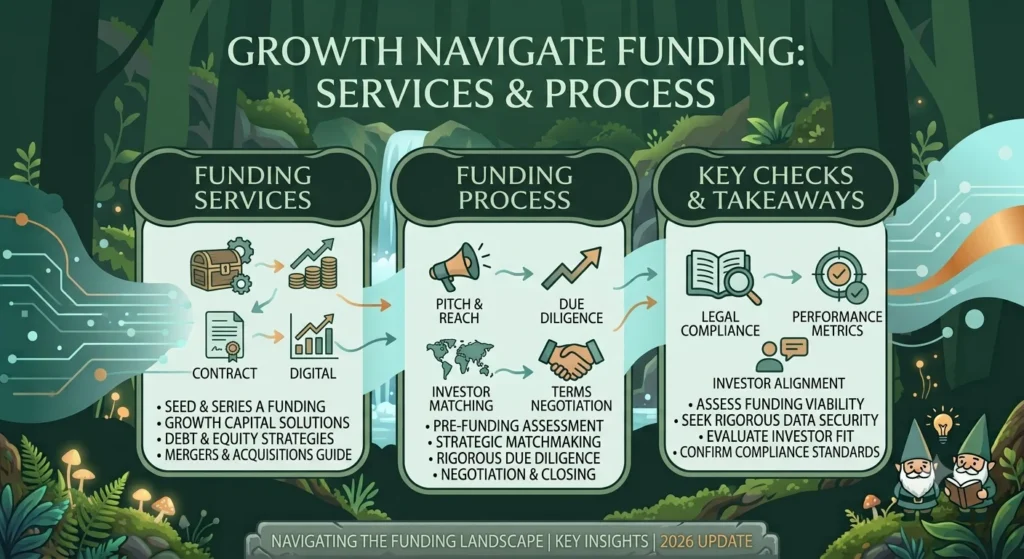
Growth Navigate Funding: Services, Pricing, Process and Key Checks.
Introduction
Raising startup capital involves much more than finding investors. Founders also need a clear funding strategy, investor-ready materials, financial projections, outreach systems, due diligence preparation, and a plan for using the capital after the round closes.
Growth Navigate Funding is a startup fundraising advisory service that positions itself around these needs. Its public website says it works with companies from pre-seed through Series C and provides fundraising strategy, pitch deck development, investor introductions, financial modeling, growth strategy, due diligence preparation, equity planning, and market expansion support.
The company also publishes specific pricing for two advisory packages and custom pricing for a more comprehensive engagement.
At the same time, many of the performance figures displayed on its website are company-reported claims. Those figures should not automatically be treated as independently audited results.
This guide explains what Growth Navigate Funding offers, how its process works, what its published packages cost, which businesses it targets, what claims it makes, and what founders should verify before signing an advisory agreement.
Quick Answer: What Is Growth Navigate Funding?
Growth Navigate Funding is a startup fundraising advisory business that helps founders prepare for and manage capital-raising campaigns.
According to its public materials, the company provides services including fundraising strategy, pitch deck development, investor relations and introductions, financial modeling, growth strategy, due diligence preparation, cap-table planning, and market expansion.
Its published service packages currently include Launchpad at $4,500 per month, Navigator at $9,500 per month, and a custom-priced Ascent package.
The company says it works with startups from pre-seed through Series C and beyond.
Growth Navigate Funding at a Glance
| Factor | Details |
|---|---|
| Business type | Startup fundraising and capital advisory |
| Primary audience | Founders and startup teams |
| Stated funding stages | Pre-seed through Series C+ |
| Main services | Fundraising strategy, pitch decks, investor access, financial modeling, growth strategy and due diligence |
| Additional services | Cap-table strategy and market expansion |
| Published Launchpad price | $4,500/month |
| Published Navigator price | $9,500/month |
| Ascent pricing | Custom |
| Claimed investor network | 1,000+ relationships |
| Company-reported capital secured | $450M+ |
| Company-reported startups funded | 300+ |
| Company-reported funding success rate | 92% |
| Company-reported average close time | 13 weeks |
| Important consideration | Performance figures are claims published by the company |
What Is Growth Navigate Funding?
Growth Navigate Funding presents itself as a capital advisory partner for startups seeking investment and growth capital.
The company says its work covers the fundraising journey from initial strategy through investor outreach, due diligence, closing, and post-funding growth.
Rather than describing itself as a lender that directly provides startup loans, its published services focus heavily on advisory and fundraising support.
That distinction matters.
A fundraising advisor can help a company prepare materials, identify potential investors, improve its financial model, organize a data room, and manage investor communication. The actual capital, however, comes from investors or financing providers involved in the transaction.
Growth Navigate Funding’s public materials identify its target stages as pre-seed through Series C and beyond.
The company also says it was founded in 2013 and operates from New York and San Francisco, with a stated client base across North America, Europe, and Asia-Pacific.
What Services Does Growth Navigate Funding Offer?
Growth Navigate Funding lists several services designed to cover different parts of a startup’s capital-raising process.
Its main offerings include:
- Fundraising strategy and roadmap development
- Pitch deck development
- Investor relations and network access
- Financial modeling
- Growth strategy advisory
- Due diligence preparation
- Cap-table and equity strategy
- Market entry and expansion strategy
These services can be purchased through different advisory packages or discussed individually.
Fundraising Strategy and Roadmaps
A successful fundraising campaign usually begins before investors receive a pitch deck.
Growth Navigate Funding says its fundraising strategy service creates a roadmap based on factors such as:
- Startup stage
- Industry
- Funding requirements
- Investor landscape
- Valuation considerations
- Funding timeline
- Competitive positioning
- Investment narrative
The company says its strategy work covers pre-seed through Series C+.
A useful fundraising roadmap should answer several practical questions:
How much capital should the company seek?
Which milestone should that capital finance?
Which investor types are relevant?
What evidence does the company need to present?
How much runway should the funding provide?
Those questions can prevent founders from treating fundraising as simply a search for the largest available check.
Pitch Deck Development
A pitch deck is one of the most visible parts of a fundraising campaign.
Growth Navigate Funding says it develops investor-focused decks covering areas such as:
- Company story
- Market opportunity
- Competitive landscape
- Financial information
- Use of funds
- Team
- Traction
- Product or solution
- Business model
The company says its standard deck architecture can contain 12–15 slides, alongside teaser and executive-summary versions.
A good deck should do more than look professional.
Investors typically need to understand the problem, solution, market, business model, traction, economics, team, competitive position, and funding requirement without having to reconstruct the story themselves.
For that reason, financial accuracy and narrative clarity are both important.
Investor Relations and Network Access
Another major part of Growth Navigate Funding’s offering is investor access.
The company says it maintains relationships with more than 1,000 active investors, including:
- Venture capital firms
- Angel investors
- Family offices
- Strategic corporate investors
Its service description also mentions targeted investor lists, warm introductions, outreach management, meeting preparation, follow-up, and term-sheet support.
Investor introductions can be valuable when they genuinely match the company’s stage, sector, geography, and funding requirements.
However, founders should ask an advisor exactly what “investor access” means.
Important questions include:
- Are introductions genuinely warm?
- How many investors are relevant to the company’s sector?
- Are contacts actively investing?
- How recently has each investor made comparable investments?
- Does the advisor guarantee introductions or only provide a list?
- How is investor outreach tracked?
- Who controls the relationship after an introduction?
A large contact database does not automatically translate into successful fundraising.
Financial Modeling and Projections
Financial models help investors understand how a startup expects to generate revenue, manage costs, use capital, and reach future milestones.
Growth Navigate Funding says its financial modeling service includes:
- Three-statement financial models
- Revenue forecasts
- Unit economics
- Cohort analysis
- Scenario planning
- Sensitivity analysis
- Cap-table modeling
- Investor-ready charts
These models can become particularly important during due diligence.
Founders should be able to explain the assumptions behind their projections.
For example, an investor may question:
- Customer acquisition costs
- Churn
- Gross margins
- Revenue growth
- Hiring plans
- Cash burn
- Pricing
- Expansion costs
A sophisticated spreadsheet is not useful if the underlying assumptions cannot withstand questioning.
Growth Strategy Advisory
Growth Navigate Funding also offers advisory support after a funding round.
Its published service description includes:
- Go-to-market planning
- Revenue optimization
- Product-market-fit refinement
- Customer acquisition strategy
- OKR frameworks
- Board reporting
- Follow-on funding preparation
- Bridge financing strategy
- M&A and exit planning
This expands the service beyond fundraising itself.
The reasoning is straightforward: raising capital is only one stage of building a company. Founders still need to turn the capital into measurable progress.
The company says its growth strategy work includes a post-funding 90-day roadmap.
Due Diligence Preparation
Due diligence can become a major part of a startup financing process.
Investors may request financial, legal, operational, technical, ownership, and commercial information before completing a transaction.
Growth Navigate Funding says its due-diligence service includes:
- Virtual data-room organization
- Legal and financial document preparation
- Assumption testing
- Scenario modeling
- Investor Q&A preparation
- Mock sessions
- IP and technology documentation review
- Reference and background-check preparation
Preparation can reduce delays because missing documents or inconsistent information can create additional questions.
Founders should still have qualified legal and financial professionals review documents where appropriate.
An advisory firm should not replace specialist legal, tax, accounting, or regulatory advice when those services are required.
Cap Table and Equity Strategy
Equity management becomes increasingly important as a startup raises multiple rounds.
Growth Navigate Funding says it provides support for:
- Cap-table modeling
- Dilution analysis
- Employee option pools
- Investor rights
- Protective provisions
- Term-sheet support
- Waterfall analysis
- Exit scenarios
The basic issue is ownership.
Every equity financing can change who owns what percentage of the company.
Founders should therefore understand the effect of:
- New shares
- Existing investor ownership
- Option pools
- Convertible instruments
- SAFEs or similar securities
- Liquidation preferences
- Future financing assumptions
A cap table should be accurate before negotiations begin, not reconstructed after an investor asks for it.
Market Entry and Expansion
Growth Navigate Funding also lists market-entry and expansion advisory services.
The company says this work can cover:
- Target-market identification
- Opportunity sizing
- Competitive analysis
- Geographic expansion
- Customer-segment expansion
- Channel strategy
- Partnerships
- Regulatory landscape review
- Expansion planning
This service is aimed more at companies that already have funding and are preparing to scale into additional markets.
Capital alone does not guarantee successful expansion.
A new market may require different pricing, regulations, distribution partners, hiring plans, customer acquisition strategies, and operational resources.
How the Growth Navigate Funding Process Works
The company’s public website describes a four-step process.
1. Discovery and Strategy
The process begins with an assessment of the startup’s story, market, stage, and funding objectives.
The stated goal is to create a fundraising roadmap.
2. Materials and Positioning
The next stage focuses on fundraising materials.
This can include:
- Pitch deck
- Financial model
- Investor narrative
- Supporting materials
3. Investor Outreach
Growth Navigate Funding says it then uses its investor network for introductions and manages outreach to investors that align with the raise.
The quality of investor matching is more important than simply increasing the number of contacts.
4. Close and Scale
The final stage covers term-sheet and closing support, followed by post-funding growth assistance where included in the engagement.
The company says the typical process for its clients can take around 10–16 weeks, depending on factors such as stage, raise size, and market conditions.
That timeframe should be viewed as an estimate rather than a guaranteed fundraising schedule.
Growth Navigate Funding Pricing
One of the more useful details on the company’s public services page is its published package pricing.
| Package | Published price | Selected services |
|---|---|---|
| Launchpad | $4,500/month | Strategy session, deck review, investor list, model health check, monthly advisory |
| Navigator | $9,500/month | Deck development, financial model, targeted investor list, warm introductions, weekly calls, data room and cap-table review |
| Ascent | Custom | Full-service fundraising, senior advisor, investor introductions, due diligence, term-sheet support and post-close advisory |
The company describes Launchpad as an entry-level advisory package and Navigator as its more comprehensive published package.
Ascent uses custom pricing.
The pricing page also states that a free 30-minute discovery call is available.
Potential clients should confirm the current price, contract length, included services, additional expenses, termination terms, and any success-based fees before signing.
Who Is Growth Navigate Funding For?
Based on its published services, the company appears most relevant to startup founders that are actively preparing for or conducting a fundraising campaign.
Potential users include:
Pre-seed founders
Early-stage teams may need help developing their narrative, financial assumptions, investor materials, and initial investor strategy.
Seed-stage companies
Companies with early traction may need a more structured approach to investor targeting and fundraising preparation.
Series A and later startups
More mature companies may require financial modeling, due diligence, cap-table analysis, investor relations, and follow-on fundraising support.
Founders entering new markets
Companies preparing for geographic or customer-segment expansion may also consider its market-entry advisory services.
The right fit depends on the startup’s actual requirements and the scope of the proposed engagement.
What Results Does Growth Navigate Funding Report?
The company publishes several performance figures on its own website.
Its homepage currently states:
- $450M+ capital secured
- 300+ startups funded
- 92% funding success rate
- 1,000+ active investor relationships
Its services pages also publish figures such as a 91% average deck open rate and hundreds of financial models and cap tables.
The company’s About page additionally gives an average close time of approximately 13 weeks.
These numbers should be described as company-reported figures.
The public pages reviewed do not establish that these metrics have been independently audited.
That does not make the claims false. It simply means prospective customers should distinguish between marketing claims and independently verified performance data.
How Should Founders Evaluate These Claims?
Before relying on performance statistics, ask for additional context.
For example:
What does “funding success rate” mean?
Does it mean any amount of capital raised, the full target amount, a signed term sheet, or another outcome?
What period does the statistic cover?
A percentage without a defined measurement period is difficult to interpret.
What counts as a funded startup?
Ask whether the figure includes every client or only certain engagements.
What does “capital secured” include?
Clarify whether the number includes equity, debt, bridge financing, or other capital.
Can comparable client references be provided?
Speaking with previous clients can provide more useful context than a headline statistic.
What services were included?
Outcomes can differ substantially depending on whether a client purchased deck support, investor outreach, full-service fundraising, or another package.
Potential Benefits of Using a Funding Advisor
A specialized advisor can potentially help founders in several areas.
More structured preparation
A defined process can help organize fundraising tasks.
Investor targeting
Founders may save time by focusing outreach on investors that match their stage and sector.
Professional fundraising materials
Pitch decks and financial models can receive specialist attention.
Due diligence preparation
Organized documentation may reduce avoidable delays.
Strategic perspective
An outside advisor may identify weaknesses that the internal team has overlooked.
Post-funding planning
Some advisory packages extend beyond closing into growth and expansion.
These potential benefits depend heavily on the advisor’s actual execution and the startup’s circumstances.
Limitations and Questions to Ask Before Hiring
Hiring a fundraising advisor involves a financial commitment, so founders should review the agreement carefully.
Ask about:
- Monthly fees
- Contract duration
- Cancellation terms
- Success fees
- Additional charges
- Investor introduction expectations
- Data confidentiality
- Ownership of pitch materials
- Who handles investor communication
- Legal and regulatory responsibilities
- Conflicts of interest
- Client references
- Specific deliverables
The most important question is not simply “Can you help us raise money?”
It is:
“Exactly what work will you perform, how will success be measured, and what will we pay regardless of the fundraising outcome?”
A clear answer makes it easier to compare advisory services with handling the raise internally.
Growth Navigate Funding vs. Independent Fundraising
| Factor | Growth Navigate Funding Advisory | Independent Fundraising |
|---|---|---|
| Strategy | External advisory support | Founder-led |
| Pitch deck | Professional assistance available | Built internally or outsourced separately |
| Investor access | Company says it provides network access | Founder builds network |
| Financial modeling | Advisory service available | Internal finance team or consultant |
| Due diligence | Preparation support available | Founder/team manages process |
| Cost | Advisory fees apply | Potentially lower direct advisory cost |
| Time commitment | Shared with advisor | Primarily founder/team responsibility |
| Control | Shared execution | Greater direct control |
| Network development | Can leverage advisor relationships | Founder develops relationships over time |
Neither approach guarantees investment.
The better option depends on the startup’s internal expertise, fundraising experience, available time, investor network, and budget.
Final Takeaway
Growth Navigate Funding is positioned as a startup fundraising advisory business rather than simply a source of capital.
Its published services cover much of the fundraising workflow, including strategy, pitch decks, investor targeting, financial modeling, due diligence, equity planning, and post-funding growth support.
The company also publishes clear package pricing, with Launchpad listed at $4,500 per month, Navigator at $9,500 per month, and Ascent available through custom pricing.
Several performance figures appear prominently across its website, including claims of more than $450 million in capital secured, more than 300 startups funded, a 92% funding success rate, and more than 1,000 investor relationships. Those numbers should be treated as company-reported claims unless independently verified.
For founders considering the service, the most useful next step is not to focus solely on headline statistics. Instead, review the proposed scope of work, pricing, contract terms, investor-access process, confidentiality provisions, deliverables, and references from comparable clients.
A fundraising advisor can potentially reduce the administrative and strategic burden of raising capital. However, the startup still needs a credible business model, defensible market opportunity, appropriate financial assumptions, and a compelling reason for investors to participate.
Ultimately, Growth Navigate Funding is best understood by looking at what it actually delivers under a specific engagement, rather than assuming that its published marketing metrics predict an individual company’s fundraising outcome.
What is Growth Navigate Funding?
Growth Navigate Funding is a startup fundraising advisory service that offers strategy, pitch decks, investor access, financial modeling, due diligence preparation, equity planning, and growth advisory.
Is Growth Navigate Funding a lender?
Its public materials primarily present it as a fundraising and capital advisory service rather than a conventional lender directly providing startup loans.
How much does Growth Navigate Funding cost?
The published Launchpad package costs $4,500 per month, while Navigator costs $9,500 per month. The Ascent package uses custom pricing.
What funding stages does Growth Navigate Funding support?
The company says it works with startups from pre-seed through Series C and beyond.
Does Growth Navigate Funding guarantee funding?
The presence of advisory services or reported success statistics should not be interpreted as a guarantee that a particular startup will receive funding. Investment decisions ultimately depend on investors, transaction terms, company performance, market conditions, and other factors.