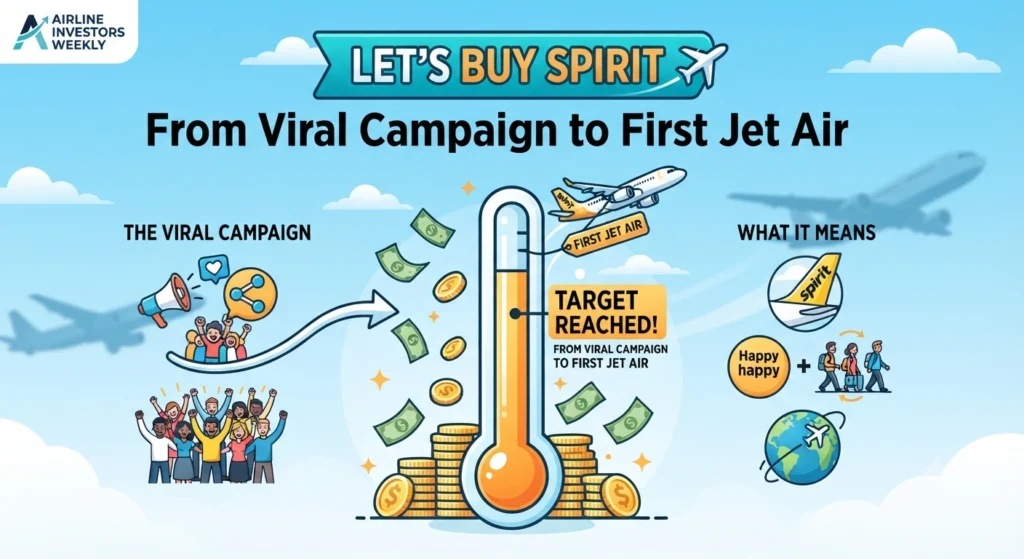
Let’s Buy Spirit Explained: From Viral Campaign to First Jet Air.
Introduction
The phrase Let’s Buy Spirit became one of the most unusual airline stories of 2026. What started as a social-media idea to collectively buy and revive Spirit Airlines quickly attracted hundreds of thousands of supporters and millions of dollars in non-binding pledges.
The story did not end with a Spirit Airlines acquisition, however. After the original campaign failed to acquire the defunct airline’s assets, the project changed direction. By August 2026, the initiative had moved toward a new concept: building a community-oriented airline from the ground up. The project has since been associated with the name First Jet Air.
That change makes “Let’s Buy Spirit” more than a search about a failed airline purchase. It now refers to the early stage of a broader airline project inspired by Spirit’s shutdown and a desire among supporters to create a different ownership model.
This guide explains what happened, how the campaign developed, what the new airline concept involves, and what readers should understand before treating online pledges or investment opportunities as ownership.
Quick Answer: What Is Let’s Buy Spirit?
| Question | Answer |
|---|---|
| What was Let’s Buy Spirit? | A viral campaign that sought community pledges toward acquiring Spirit Airlines after it stopped operating. |
| Who started it? | Social-media creator and voice actor Hunter Peterson. |
| Did the campaign buy Spirit Airlines? | No. The campaign later moved away from acquiring Spirit’s assets. |
| What happened next? | The project shifted toward building a new community-oriented airline. |
| What is the newer airline project called? | First Jet Air has been presented as the next stage of the project. |
| Is it the original Spirit Airlines? | No. First Jet Air is a separate project rather than the former Spirit Airlines operating as before. |
| Were the original pledges the same as investments? | No. Early campaign pledges were presented as non-binding commitments rather than completed investments. |
| What should people check before investing? | Offering documents, regulatory information, company details, risks, terms and how the money will be used. |
What Was the Let’s Buy Spirit Campaign?
Let’s Buy Spirit was a grassroots-style online campaign created shortly after Spirit Airlines stopped operating in May 2026.
The idea came from Hunter Peterson, a social-media creator and voice actor. Peterson proposed that a large number of ordinary travelers could collectively contribute an amount comparable to the price of a Spirit ticket and use the money to purchase the airline.
The concept spread rapidly through TikTok and other social platforms. Early coverage reported that the campaign’s website recorded tens of thousands of supporters and tens of millions of dollars in non-binding pledges within days. Later reports put the number of pledges and stated amounts much higher.
Those figures need an important qualification: pledged money is not the same as money actually raised.
The early website allowed people to express an intention to participate. It did not mean that the campaign had accumulated hundreds of millions of dollars in cash that could immediately be used to purchase an airline.
That distinction became increasingly important as the campaign grew.
How Did the Idea Start?
The original idea reportedly came from a TikTok video posted after Spirit Airlines announced that it would cease operations.
Peterson’s basic calculation was straightforward: if millions of people each contributed a relatively small amount, the collective pool could become large enough to pursue an airline acquisition.
The concept was deliberately accessible. Instead of presenting airline ownership as something reserved for large corporations or institutional investors, the campaign framed it as a community project.
Early media coverage reported rapid growth. One report said the campaign’s website showed more than 36,000 founding patrons and approximately $22.8 million in pledges within its first days. Other reporting later documented significantly higher figures as interest continued.
The website also experienced heavy traffic, illustrating how quickly the idea spread online.
Why Did Spirit Airlines Become the Focus?
Spirit Airlines had operated as a major ultra-low-cost carrier in the United States before its financial problems culminated in the end of operations in 2026.
That history made the airline an obvious focus for a community ownership campaign.
Spirit was known for its low base fares and additional fees for various services. Its business model targeted price-sensitive travelers, making the idea of preserving an affordable airline particularly appealing to people who regularly looked for low-cost flights.
Once the airline stopped flying, supporters of the campaign saw an opportunity to preserve the underlying concept while changing who controlled it.
The challenge was that an airline is not simply a collection of aircraft with a recognizable brand.
An operating carrier requires aircraft, employees, airport access, regulatory approvals, financing, maintenance capabilities, technology, insurance, operational systems and an appropriate certificate structure.
Those requirements made a rapid community acquisition much more complicated than simply reaching a fundraising target.
What Happened to the Original Buyout Plan?
The original campaign ultimately did not acquire Spirit Airlines’ assets.
By August 2026, reporting indicated that the initiative had abandoned its initial acquisition strategy and shifted toward creating a new airline. The project began describing the next phase as “Let’s Build an Airline.”
This distinction is essential when researching the phrase “Let’s Buy Spirit.”
Someone searching for the term may find older articles discussing a proposed purchase of Spirit Airlines. Those reports describe an earlier stage of the project.
Current information points toward a different objective: building a new airline rather than simply buying the former Spirit operation.
The transition also explains why newer references increasingly use terms such as Spirit 2.0, Let’s Build an Airline, and First Jet Air.
From Let’s Buy Spirit to Let’s Build an Airline
The project’s change in direction represents a significant shift.
Instead of trying to purchase a liquidating airline, the team began promoting the idea of creating a new carrier with community participation.
A report published in August 2026 described the proposed model as similar to a membership-based airline. Under the concept, members could receive access to lower fares or other benefits, while the organization would seek to build a new aviation business.
The project’s founder has also described the effort as something that evolved from the original “Let’s Buy Spirit” campaign into an attempt to build an airline publicly.
That evolution matters for readers because older search results may still describe the project as an attempt to purchase Spirit Airlines.
The current concept is different.
What Is First Jet Air?
First Jet Air is the airline project associated with the next stage of the movement.
Its public description says the project evolved from the original attempt to buy Spirit Airlines and is now focused on creating an airline owned by the people who fly it. The company’s LinkedIn page describes it as an airlines-and-aviation company founded in 2026.
The project has promoted a community-oriented ownership concept in which passengers could have an economic connection to the airline rather than functioning solely as customers.
First Jet Air’s public messaging emphasizes three broad ideas:
- Community participation
- Affordable air travel
- Passenger-oriented ownership
The project has also indicated that investment activity would open in September 2026. A recent public update from First Jet Air stated that its website was live and referenced September 9 as the planned investment-opening date.
Anyone considering participation should distinguish between the project’s promotional descriptions and the legally binding terms contained in its actual offering documents.
How Could a Community-Owned Airline Work?
The proposed concept differs from a conventional airline ownership structure.
Traditional airlines can have shareholders ranging from individual investors to large institutions. Customers purchase tickets but generally do not receive ownership simply because they fly.
The First Jet concept is built around a different relationship between passengers and the airline.
The broader proposal has been described as a membership-style or community-owned airline. Earlier reporting said the project considered a structure in which customers could purchase memberships for access to lower fares, while the organization would operate the airline through an appropriate regulatory and aviation framework.
A possible model could involve several layers:
Passenger membership
Travelers could pay for membership and receive access to specific benefits.
Community ownership
Eligible participants could potentially have an ownership interest, depending on the final legal structure and offering.
Airline operations
The organization would still need qualified aviation partners, aircraft, pilots, maintenance systems, airport arrangements and regulatory approvals.
Long-term certification
A new carrier may eventually need its own operating authority or another legally compliant structure for conducting flights.
These details are not interchangeable. A company can market flights, organize memberships or raise capital without immediately becoming a fully independent airline operating every flight itself.
What Happened to the Original Pledges?
This is one of the most important questions surrounding Let’s Buy Spirit.
The original campaign attracted substantial pledges, but those pledges should not automatically be described as completed investment capital.
A pledge expresses an intention or commitment under the terms presented at the time. An investment involves a legally structured transaction with defined terms, documentation and financial consideration.
Reports from the campaign’s early period used the word “pledges” when describing the large figures displayed by the website.
That distinction prevents a common misunderstanding:
$X in pledges does not necessarily mean $X was deposited into a company bank account.
The later transition toward building a new airline also means readers should examine the terms of any newer funding opportunity separately from the original pledge campaign.
Do not assume that joining the original campaign automatically means you own part of First Jet Air.
Is First Jet Air the Same as Spirit Airlines?
No.
This distinction should be clear.
Spirit Airlines was the established carrier that ceased operations in May 2026. The original Let’s Buy Spirit campaign attempted to acquire it or its assets.
First Jet Air represents a new airline project that emerged from the movement after the original acquisition effort changed direction. Its public profile describes the project as building an airline from the ground up rather than simply continuing the former Spirit Airlines operation.
The name “Spirit 2.0” may therefore appear in discussions about the project, but that phrase should not be interpreted as proof that the original Spirit Airlines has returned.
Brand identity, aircraft, operating certificates, routes and corporate assets are separate matters.
Investment and Financial Considerations
The investment aspect deserves careful attention because the project has moved beyond the original viral pledge campaign.
Public participation in a startup airline can involve substantial risk. Aviation requires significant capital, and a new carrier may face expenses long before it generates meaningful passenger revenue.
Potential financial considerations include:
- Aircraft acquisition or leasing
- Maintenance
- Fuel
- Airport fees
- Labor
- Insurance
- Technology
- Customer support
- Regulatory compliance
- Marketing
- Aircraft utilization
- Route development
- Working capital
A community ownership idea can change the relationship between travelers and an airline, but it does not eliminate the underlying economics of aviation.
Anyone evaluating an investment should read the actual offering documents rather than relying on social-media posts or viral pledge totals.
Important questions include:
- What legal entity receives the investment?
- What security or ownership interest is being offered?
- What are the voting rights?
- What happens if the airline never launches?
- What expenses can the company use investor funds for?
- What are the dilution provisions?
- What are the risks described in the offering documents?
- Are there restrictions on selling the investment?
- What regulatory exemptions or filings apply?
- What happens if the company needs additional capital?
These questions matter for any early-stage airline investment.
Why Building an Airline Is Complicated
The viral nature of Let’s Buy Spirit can make airline creation sound simpler than it is.
An airline must satisfy multiple operational and regulatory requirements before it can safely carry passengers.
Regulatory approval
Passenger airlines operating in the United States must comply with federal aviation requirements. Certification and operating authority involve extensive regulatory oversight.
Aircraft
A new airline needs access to suitable aircraft. Buying aircraft requires enormous capital, while leasing still creates substantial fixed obligations.
Maintenance
Aircraft require scheduled inspections, repairs and continuing airworthiness programs.
Crew
Qualified pilots, flight attendants, mechanics and operational personnel are essential.
Airports
Routes require airport access, gates, handling arrangements and other infrastructure.
Technology
Reservation systems, payment processing, operations software, baggage systems and customer-service technology all require investment.
Cash flow
Airlines have high operating costs. A company can sell tickets and still experience significant financial pressure if costs rise faster than revenue.
For these reasons, a successful airline launch involves much more than attracting passengers on social media.
Potential Advantages of the Community Model
The proposed model does introduce some interesting possibilities.
A built-in community
The original campaign demonstrated that a large online audience can form around an airline concept before the airline itself exists.
Customer-focused incentives
If customers also have an ownership or membership relationship, the company could potentially align some business decisions with frequent travelers’ interests.
Alternative funding
Community investment can provide an additional source of capital beyond traditional airline financing.
Brand participation
Supporters may feel more connected to a carrier if they can participate in its development.
None of these possibilities guarantees commercial success. The actual outcome depends on the legal structure, financing, management, operational execution and regulatory process.
Key Challenges to Watch
The biggest questions concern execution.
A community can create attention quickly, but an airline needs durable systems.
Readers following First Jet Air should watch for developments involving:
- Regulatory approvals
- Aircraft acquisition or leasing
- Operating partners
- Airport agreements
- Executive and aviation leadership
- Funding rounds
- Formal investment documents
- Route announcements
- Launch schedules
- Safety and operational certifications
Those milestones provide more useful evidence of progress than social-media follower counts or viral videos.
How to Verify Information About Let’s Buy Spirit
Search results can be confusing because the project has gone through several stages.
Use the following approach when researching it:
Check the date
A May 2026 article may describe the original buyout campaign. An August or September 2026 report may describe the newer airline project.
Separate pledges from investments
Look for precise language. “Pledged,” “committed,” “raised,” and “invested” can describe very different financial situations.
Check the current company
If a source discusses First Jet Air, confirm whether it is describing the current organization rather than Spirit Airlines itself.
Read primary documents
For investment decisions, look for the company’s actual offering materials and regulatory filings rather than relying only on social-media commentary.
Be careful with unofficial websites
The popularity of the original campaign attracted copycat domains and scam concerns. Early reports specifically warned users about unofficial sites requesting money or financial information.
Never assume a website is legitimate simply because it contains the words “Spirit,” “Spirit 2.0,” or “Let’s Buy Spirit.”
Frequently Asked Questions
What does “Let’s Buy Spirit” mean?
It originally referred to a 2026 online campaign that attempted to organize community pledges toward buying and reviving Spirit Airlines after the carrier stopped operating.
Did Let’s Buy Spirit successfully purchase Spirit Airlines?
No. The campaign did not acquire Spirit Airlines’ assets and later changed direction toward building a new airline.
Who started Let’s Buy Spirit?
The campaign was launched by Hunter Peterson, a social-media creator and voice actor who proposed the community-funded airline idea after Spirit ceased operations.
What is First Jet Air?
First Jet Air is the newer airline project that emerged from the original Let’s Buy Spirit movement. Its public description focuses on creating an airline designed around community and passenger ownership.
Is First Jet Air Spirit Airlines?
No. First Jet Air is a separate new airline project. It emerged after the original effort to purchase Spirit Airlines changed direction.
Were the original Let’s Buy Spirit pledges investments?
Not necessarily. Early campaign figures were described as non-binding pledges. A pledge should not automatically be treated as completed investment capital.
Can people invest in the new airline project?
First Jet Air has publicly discussed investment activity, including a September 2026 investment opening. Anyone considering participation should review the current offering documents, eligibility requirements, risks and legal terms before committing money.
Why did the campaign change from buying Spirit to building an airline?
The campaign did not obtain the assets it initially sought from the liquidating Spirit operation. The project subsequently shifted toward building a new airline rather than acquiring the former carrier.
Final Takeaway
Let’s Buy Spirit started as a viral idea for community-funded airline ownership after Spirit Airlines ceased operations in May 2026. Within days, the campaign attracted widespread attention and large amounts of non-binding pledges.
The story has since moved in a different direction.
Rather than purchasing the former Spirit Airlines, the project evolved into an effort to build a new airline, with First Jet Air now presenting itself as the next stage of that initiative.
That distinction is crucial for anyone researching the topic today. The original Spirit Airlines is not simply returning under a new website. The current project involves a new organization, a different strategy and a new set of operational and financial challenges.
For travelers, aviation enthusiasts and potential participants, the most useful approach is to follow verified company updates, regulatory developments and formal documents. Viral pledge totals can explain how much public interest a project generated, but they do not establish that an airline has been funded, certified or launched.