
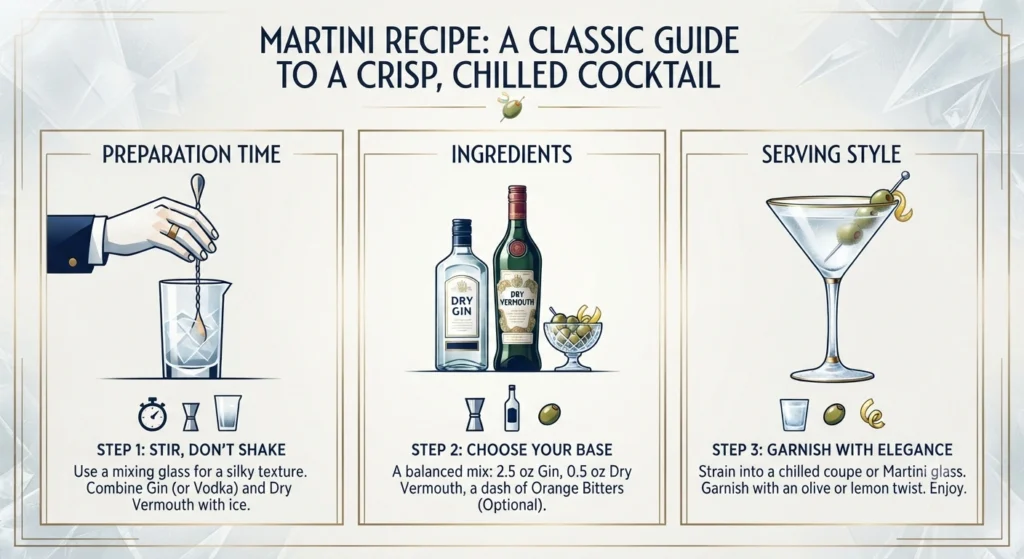
Martini Recipe: A Classic Guide to a Crisp, Chilled Cocktail.
Introduction
Few cocktails are as recognizable as a classic Martini Recipe . Its clean appearance, chilled glass, botanical aroma and simple ingredient list make it look effortless. Yet a good Martini depends heavily on small decisions: the spirit you choose, the amount of vermouth, the quality of the ice, the dilution and even the garnish.
A traditional Dry Martini is built around gin and dry vermouth, with some modern recipes adding orange bitters and a lemon twist. One widely used modern formula combines 2½ ounces of gin with ½ ounce of dry vermouth and a dash of orange bitters. The mixture is stirred with ice until thoroughly chilled before being strained into a cold cocktail glass.
The beauty of a Martini is its flexibility. You can make it crisp and spirit-forward, use vodka instead of gin, increase the vermouth for a softer drink, or explore variations such as the 50/50 Martini, Reverse Martini, Dirty Martini and Gibson.
This guide explains how to make a classic Martini at home, how to choose your ingredients, why stirring matters, how to adjust the gin-to-vermouth ratio and which variations are worth trying.
Classic Martini Recipe at a Glance
If you want a straightforward starting point, use this formula:
| Ingredient | Amount |
|---|---|
| Gin | 2½ oz / about 75 ml |
| Dry vermouth | ½ oz / about 15 ml |
| Orange bitters | 1 dash, optional |
| Ice | Plenty for stirring |
| Garnish | Lemon twist |
| Glass | Chilled Martini or coupe glass |
This recipe follows a commonly used Dry Martini format. Liquor.com recommends a London dry-style gin, dry vermouth, optional orange bitters and a lemon twist, with the drink stirred rather than shaken.
Yield: 1 Martini
Preparation time: About 3–5 minutes
What Is a Martini?
A Martini is a classic cocktail traditionally associated with gin and vermouth.
The exact history of the drink is difficult to pin down. Cocktail historians have proposed several origins, and earlier versions differed considerably from the dry, spirit-forward Martini commonly served today. Historical recipes used different styles of gin, different vermouths and varying proportions.
Modern drinkers often think of a Martini as a combination of:
- Gin or vodka
- Dry vermouth
- Ice
- A garnish such as lemon or olive
The proportion of spirit to vermouth can change the entire personality of the cocktail.
A Martini with very little vermouth will taste more spirit-forward and dry. Increasing the vermouth creates a softer, more aromatic drink.
Ingredients You Need
1. Gin
Gin is the traditional base spirit for the classic Martini.
A London Dry-style gin is a common choice because its juniper-forward character works naturally with dry vermouth. However, modern gins can bring citrus, floral, herbal or spice notes to the drink.
If you’re making your first Martini, choose a gin you genuinely enjoy drinking on its own. The Martini contains very few ingredients, so the base spirit remains highly noticeable.
2. Dry Vermouth
Dry vermouth is not simply a minor ingredient.
It contributes herbal, floral and bitter notes while softening the intensity of the spirit. The amount you use is one of the easiest ways to customize the cocktail.
Keep your vermouth refrigerated after opening. Unlike distilled spirits, vermouth is a fortified wine and its flavor can deteriorate with prolonged exposure to oxygen.
3. Ice
Good ice matters more than many beginners expect.
The ice needs to chill the cocktail while adding the right amount of dilution. Large, solid cubes are useful for stirring because they melt more slowly than small, rapidly melting pieces.
4. Orange Bitters
Orange bitters are optional in many modern Martini recipes.
A small amount can add subtle citrus and spice notes while connecting the botanicals of the gin with the vermouth. Liquor.com includes one dash in its Dry Martini recipe.
5. Garnish
Two classic choices are:
- Lemon twist
- Green olive
A lemon twist adds bright citrus aroma. An olive introduces a savory, salty character.
Your garnish is not just decoration. Expressing a lemon peel over the surface releases citrus oils that can noticeably affect the aroma of the finished drink.
How to Make a Classic Martini
Step 1: Chill Your Glass
Place your Martini or coupe glass in the freezer for a few minutes, or fill it with ice and cold water while you prepare the cocktail.
A cold serving glass helps the drink stay chilled for longer.
Step 2: Add the Ingredients
Pour the gin, dry vermouth and optional orange bitters into a mixing glass.
For the recipe above, use:
- 2½ oz gin
- ½ oz dry vermouth
- 1 dash orange bitters
Step 3: Add Plenty of Ice
Fill the mixing glass with ice.
More ice can help create efficient chilling and controlled dilution because the ingredients are surrounded by a large cold thermal mass.
Step 4: Stir
Stir smoothly for around 20–30 seconds until the cocktail is very cold.
The goal is not simply to lower the temperature. Stirring also introduces controlled dilution. Liquor.com recommends stirring the classic Martini for approximately 20–30 seconds.
Step 5: Strain
Discard the ice from your serving glass if you used it for chilling.
Strain the Martini into the cold glass.
A properly stirred Martini should appear clear rather than cloudy with broken ice particles.
Step 6: Garnish
Finish with a lemon twist or green olive.
For a lemon garnish, twist the peel over the drink to release some of its citrus oils before placing it in or on the rim.
Why Is a Martini Usually Stirred?
This is one of the most famous Martini questions.
A classic Martini is generally stirred rather than shaken because the ingredients are spirits and fortified wine, without fruit juice, dairy or egg white that would require vigorous shaking.
Stirring chills and dilutes the drink while helping maintain a clear appearance.
Liquor.com recommends stirring a Dry Martini for 20–30 seconds.
Shaking is not inherently impossible, and popular culture has certainly made the shaken Martini famous. However, a stirred preparation is the conventional technique for the classic spirit-and-vermouth format.
What Is the Best Gin-to-Vermouth Ratio?
There is no single ratio that every Martini drinker must use.
A common modern Dry Martini formula is approximately 5 parts gin to 1 part dry vermouth. Liquor.com describes 4:1 to 8:1 as common territory for Dry Martinis, with 5:1 often used as a practical standard.
Here’s how different proportions generally affect the drink:
| Ratio | General Character |
|---|---|
| 8:1 | Very spirit-forward and dry |
| 5:1 | Classic modern Dry Martini style |
| 4:1 | Slightly more vermouth character |
| 2:1 | Wetter and more aromatic |
| 1:1 | 50/50 Martini style |
Remember that “dry” does not mean leaving vermouth out completely.
Instead, it generally refers to using less vermouth relative to the base spirit.
How to Make a Vodka Martini
A Vodka Martini follows the same basic concept but replaces gin with vodka.
Ingredients
- 2½ oz vodka
- ½ oz dry vermouth
- 1 dash orange bitters, optional
- Lemon twist or olive
Method
Add the vodka, vermouth and bitters to a mixing glass filled with ice.
Stir until very cold, then strain into a chilled cocktail glass.
Finish with a lemon twist or olive.
Liquor.com uses this basic structure for its Vodka Martini, recommending approximately 20–30 seconds of stirring.
Gin vs. Vodka
Gin brings botanical complexity, particularly juniper.
Vodka has a more neutral profile, allowing the vermouth and garnish to play a larger role.
Neither choice needs to be treated as the only acceptable Martini. They simply produce different drinks.
How to Make a 50/50 Martini
The 50/50 Martini is a useful option if a traditional Dry Martini feels too strong or too dry.
Instead of using significantly more gin than vermouth, the drink uses equal parts.
Ingredients
- 1½ oz gin
- 1½ oz dry vermouth
- 1 dash orange bitters
- Lemon twist
Method
Add everything to a mixing glass with ice.
Stir until thoroughly chilled, then strain into a chilled glass.
Finish with a lemon twist.
Liquor.com describes the 50/50 Martini as equal parts gin and dry vermouth, resulting in a less dry and lower-alcohol drink than a conventional spirit-heavy Martini.
What Is a Reverse Martini?
A Reverse Martini simply changes the balance so that dry vermouth becomes the dominant ingredient.
One established recipe uses:
- 2 oz dry vermouth
- 1 oz gin
- Olive or lemon twist
The ingredients are stirred with ice and strained into a chilled glass.
This version can be useful for people who enjoy vermouth’s herbal character and want a lighter drink.
Dry Martini vs. Wet Martini
The terms can be confusing at first.
Dry Martini
A Dry Martini generally contains a larger proportion of gin and a smaller amount of dry vermouth.
The result is typically more spirit-forward.
Wet Martini
A wetter Martini contains more vermouth.
That produces a more aromatic and softer profile, with the fortified wine playing a larger role.
Neither approach is automatically better.
Your preferred ratio depends on how prominent you want the gin and vermouth to be.
Lemon Twist or Olive?
This small choice can change the experience.
Lemon Twist
Choose a lemon twist when you want:
- Fresh citrus aroma
- A bright finish
- A cleaner aromatic profile
- More emphasis on the gin’s citrus notes
Green Olive
An olive works well when you prefer:
- Savory flavors
- Briny notes
- A richer finishing character
You can also make a Dirty Martini by adding olive brine to the cocktail.
Tips for Making a Better Martini at Home
Chill Everything
A warm Martini quickly loses its appeal.
Cold glassware, cold ingredients and plenty of ice help maintain the temperature.
Don’t Ignore Vermouth
Even if you’re making a Dry Martini, vermouth matters.
Use fresh dry vermouth and store it properly after opening.
Stir Long Enough
Under-stirring can leave the cocktail warmer and less diluted than intended.
Around 20–30 seconds is a useful starting point for a classic Martini.
Experiment With Ratios
Start with a 5:1-style recipe.
If it tastes too strong, increase the vermouth slightly. If you want a drier, more spirit-forward profile, reduce the vermouth.
Use Good Ice
Avoid small, watery ice that melts immediately.
Large, solid cubes are easier to work with when stirring.
Don’t Overdo the Bitters
Orange bitters can provide complexity, but you only need a small amount.
One dash is enough to begin experimenting.
Common Martini Mistakes
Using Old Vermouth
An opened bottle of vermouth can lose freshness over time.
Keep it refrigerated and pay attention to its aroma and flavor.
Serving It Warm
A Martini is designed to be served cold.
Chill the glass before pouring whenever possible.
Over-Diluting the Drink
Stirring is necessary, but excessive stirring with rapidly melting ice can add more water than intended.
Assuming “Dry” Means No Vermouth
Dry usually means a lower proportion of vermouth, not necessarily zero vermouth.
Using the Wrong Glass Temperature
Even a well-made Martini can become disappointing when poured into a warm glass.
Popular Martini Variations
The classic formula has inspired countless variations.
| Martini Style | Main Difference |
|---|---|
| Dry Martini | More gin, less dry vermouth |
| Vodka Martini | Vodka replaces gin |
| 50/50 Martini | Equal gin and dry vermouth |
| Reverse Martini | More vermouth than gin |
| Dirty Martini | Olive brine added |
| Gibson | Pickled onion garnish |
| Perfect Martini | Uses both dry and sweet vermouth |
| Vesper | Gin, vodka and aromatized wine-based ingredients |
Modern cocktail references include many additional variations, demonstrating how flexible the Martini format has become.
Frequently Asked Questions
What is the easiest Martini recipe?
Combine 2½ ounces of gin with ½ ounce of dry vermouth in a mixing glass filled with ice. Stir until very cold, strain into a chilled glass and garnish with a lemon twist.
Is a Martini made with gin or vodka?
A traditional Martini is associated with gin, while the Vodka Martini substitutes vodka for gin. Both styles are widely recognized today.
What is the best Martini ratio?
A 5:1 gin-to-dry-vermouth ratio is a common starting point for a modern Dry Martini, although ratios vary according to taste.
Should you shake or stir a Martini?
A classic spirit-and-vermouth Martini is generally stirred. Stirring chills and dilutes the drink while maintaining clarity.
Can you make a Martini without vermouth?
You can reduce the vermouth considerably, but removing it entirely changes the character of the cocktail. Vermouth contributes aroma, flavor and balance.
What garnish goes with a Martini?
A lemon twist and green olive are two classic choices. A lemon twist provides citrus aroma, while an olive adds a savory and sometimes briny character.
What makes a Martini “dry”?
In Martini terminology, “dry” generally means a smaller proportion of vermouth relative to the base spirit. It does not necessarily mean the cocktail contains no vermouth.
Can beginners make a Martini at home?
Yes. A Martini requires only a few ingredients and basic equipment. The most important skills are chilling, measuring, stirring and adjusting the gin-to-vermouth ratio to your taste.
Final Thoughts
A great Martini recipe does not require a complicated ingredient list.
The classic formula is remarkably simple: quality gin, dry vermouth, cold ice and a suitable garnish. What makes the cocktail interesting is the balance between those elements.
Start with a roughly 5:1 gin-to-vermouth ratio if you want a modern Dry Martini. Stir it with plenty of ice for around 20–30 seconds, strain it into a chilled glass and finish with a lemon twist or olive.
From there, you can personalize the drink.
Use vodka for a Vodka Martini, equal parts spirit and vermouth for a 50/50 Martini, or flip the proportions for a Reverse Martini. Each adjustment changes the balance without losing the basic identity of the drink.
The most useful Martini rule is simple: learn the classic formula first, then adjust it to your own palate.
Responsible drinking: Martinis are spirit-forward cocktails and can contain a substantial amount of alcohol. Enjoy responsibly, follow local drinking laws, and never drive after drinking.