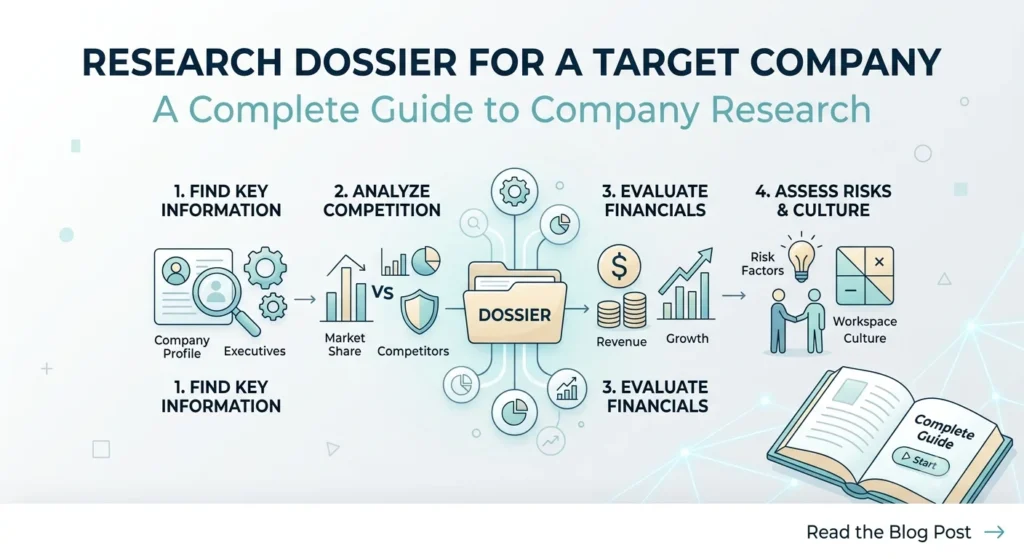
Research Dossier for a Target Company: A Complete Guide to Company Research
Introduction
Making a business decision without understanding the organisation on the other side can lead to wasted time, missed opportunities and unnecessary risk. A sales team may approach a company without knowing its priorities. An investor may overlook important financial concerns. A business owner might choose a supplier without checking its track record, ownership or market reputation.
A research dossier for target company helps solve this problem by bringing relevant business information together in one structured document. Rather than relying on scattered search results, a company’s marketing materials or informal assumptions, researchers can build a clearer picture of how the organisation operates, what it offers, how it competes and what deserves further investigation.
This approach is useful for sales prospecting, competitor analysis, investment research, mergers and acquisitions, supplier selection, partnership planning and professional preparation.
However, an effective dossier is not simply a long collection of company facts. It should have a clear purpose, use credible sources, distinguish verified information from assumptions and turn findings into practical insights.
In this guide, you will learn what a research dossier for a target company is, which sections to include, how to gather reliable information, how to analyse findings and how to create a reusable template for future research projects.
Quick Answer: What Is a Research Dossier for a Target Company?
A research dossier for a target company is a structured report that collects and analyses relevant information about a specific business to support a decision. It may cover company background, ownership, leadership, products, customers, financial performance, competitors, market position, recent developments and potential risks.
The word target simply means the company being investigated. It does not necessarily refer to the American retailer Target Corporation.
| Detail | Explanation |
|---|---|
| Main purpose | Understand a company before making a business decision |
| Common users | Sales teams, investors, marketers, consultants and business owners |
| Core information | Company profile, business model, leadership, market position and risks |
| Research sources | Official websites, company reports, regulatory filings and credible news |
| Typical output | A structured document, spreadsheet or internal research report |
| Main benefit | Helps organise evidence and identify relevant opportunities and concerns |
| Important limitation | Available information varies by company, industry and jurisdiction |
A good dossier answers three essential questions: What do we know about the company? How reliable is the evidence? What does the information mean for the decision being considered?
1. What Is a Research Dossier for a Target Company?
A research dossier is a consolidated record of information about a particular organisation. It brings together relevant facts, supporting evidence, analytical observations and unanswered questions.
The exact structure depends on why the research is being conducted. Someone preparing for a sales meeting may need to understand the company’s services, business priorities and potential purchasing needs. An investor may need a much deeper examination of financial performance, ownership and business risks.
A basic company profile typically contains details such as the business name, website, industry, location and products. A research dossier builds on this information by examining how the organisation operates and what its position means for a specific decision.
Research dossier vs company profile
These terms are related, but they are not identical.
A company profile provides a general introduction to a business. It may explain what the company does, where it operates and who its customers are.
A research dossier is more analytical. It connects company information with evidence, market context, potential risks and practical conclusions.
For example, a profile might state that a company provides software to small businesses. A dossier could investigate its pricing model, target customers, major competitors, product development, reported financial performance and potential commercial opportunities.
Is a target company research dossier the same as due diligence?
Not necessarily.
A research dossier can support due diligence, but the two are not interchangeable. A preliminary dossier may rely mainly on public information and help determine whether deeper investigation is worthwhile.
Formal due diligence is usually more extensive. Depending on the transaction, it may involve reviewing contracts, financial statements, tax records, legal obligations, intellectual property, cybersecurity and operational controls.
For a major acquisition, investment or contractual commitment, public research alone may be insufficient. Specialist legal, financial and other professional reviews may be necessary.
2. Why Is a Target Company Research Dossier Important?
A well-prepared dossier can make company research more focused and useful. Instead of repeatedly searching for the same details, researchers have one organised reference document that records what is known and what remains uncertain.
It supports informed decisions
Business decisions often involve incomplete information. A structured dossier helps decision-makers compare evidence, identify unanswered questions and understand the possible implications of their findings.
For example, a company might appear attractive as a potential supplier because it offers competitive pricing. Further research could reveal limited service coverage, unclear contractual terms or a lack of independent evidence about its capabilities.
These findings do not automatically mean the supplier is unsuitable. They indicate which areas require closer examination before a commitment is made.
It improves sales prospecting
Sales teams can use a dossier to understand a prospective customer’s business before making contact.
Useful research may include the company’s products, customer segments, recent announcements, expansion plans and publicly stated priorities. This information helps sales representatives prepare more relevant conversations instead of sending generic messages.
However, research should remain professional and proportionate. Use legitimate business information, avoid intrusive personal profiling and respect applicable privacy and marketing rules.
It strengthens competitor analysis
A competitor dossier helps businesses understand how other organisations position their products, communicate value and serve customers.
Research might cover service offerings, pricing that is publicly disclosed, target markets, distribution channels, published case studies and product launches.
The purpose is not to copy another company’s strategy. Rather, the goal is to identify differences, understand market expectations and discover opportunities to provide better value.
It helps identify risks
Company research can reveal warning signs that deserve further verification, such as inconsistent corporate information, unclear ownership, deteriorating reported performance or significant unresolved questions about a proposed partnership.
A dossier should distinguish a confirmed problem from a potential concern. For instance, an unanswered question about ownership is not proof of wrongdoing; it is a reason to seek reliable clarification.
It saves time across teams
When information is stored consistently, multiple people can work from the same evidence base.
A sales team, marketing department or research team can update the dossier as new developments emerge. Recording sources and research dates also makes it easier to revisit important claims without starting from scratch.
3. What Should a Research Dossier Include?
A useful dossier covers the areas that matter to its research objective. The following sections provide a flexible framework for most company research projects.
1. Company overview
Start with the basic identity of the business.
Record the official or legal company name, trading name if applicable, website, industry, headquarters, operating markets, business type and principal products or services.
Where reliable information is available, include the founding date, employee range, parent company, subsidiaries and ownership structure.
Do not assume that a brand name and legal entity are identical. Confirm the relevant entity before making decisions involving contracts, investments or partnerships.
2. Company history and milestones
Create a short timeline of important developments.
This could include the company’s founding, product launches, acquisitions, funding announcements, major partnerships, leadership changes and geographic expansion.
Prioritise events that explain the organisation’s current position. A long list of minor announcements may add volume without improving understanding.
Record the date of each event and link to the supporting source.
3. Products and services
Identify what the company sells or provides, who uses it and what problem it aims to solve.
Consider its main products, service packages, customer benefits, delivery model and publicly available pricing.
For software companies, this may include subscription plans, integrations and major product capabilities. For a manufacturer, it may involve product lines, distribution arrangements and production capabilities.
Keep confirmed product details separate from your interpretation of their commercial strengths.
4. Business model and revenue
A dossier should explain how the organisation generates income.
Possible revenue models include product sales, subscriptions, licensing, advertising, transaction fees, professional services and recurring contracts.
Record the primary customer groups, sales channels and major cost categories when this information is available.
If the company does not disclose detailed financial information, do not invent revenue figures. Instead, document what is known and identify which financial details remain unavailable.
5. Leadership and ownership
Research the company’s publicly disclosed leadership, governance structure and ownership where relevant.
Depending on the business, this could include executives, board members, founders, parent organisations and major shareholders.
Use official leadership pages, regulatory filings and other reliable records. Verify roles and dates because management positions can change.
For privately held companies, ownership information may be limited. Clearly state those limitations rather than filling gaps with unverified online claims.
6. Financial performance
For a publicly reporting company, review relevant financial statements and official disclosures.
Depending on the research objective, useful indicators may include revenue, operating profit, net income, cash flow, debt, cash reserves and changes in financial guidance.
Always record the reporting period, currency and source. A figure without a date or context can be misleading.
For private businesses, detailed financial information may not be public. Alternative sources may provide partial information, but estimates should be labelled as estimates and not presented as audited results.
7. Customers and target markets
Understand who the company serves and where its commercial focus lies.
Research customer segments, industries served, geographic markets, distribution channels and publicly disclosed customer relationships.
Case studies and testimonials can help explain the company’s value proposition, but they may be selected for promotional purposes. Do not assume that a published example represents the experience of every customer.
8. Competitors and market position
Identify relevant competitors based on actual customer needs and product overlap.
Compare factors such as service range, pricing where available, target audience, geographic reach, distribution, customer experience and differentiation.
A competitor list is only the starting point. The analysis should explain where the target company appears stronger, where competitors may have an advantage and which conclusions still require evidence.
9. Recent developments and strategic priorities
Record relevant developments such as new products, acquisitions, hiring announcements, market expansion, partnerships and changes in business strategy.
Give priority to developments that could affect the research decision.
For example, a sales team may want to know whether a business has opened a new location or launched a new service. An investor may be more interested in official financial guidance or material changes in business operations.
Use publication dates and distinguish a company’s announced plans from completed actions.
10. Risks, opportunities and unresolved questions
The final analytical sections should highlight issues that could affect the decision.
Potential risks may include customer concentration, competitive pressure, regulatory exposure, supply-chain dependencies, financial constraints or reputational concerns. Opportunities might include unmet customer needs, new markets or potential areas of collaboration.
Do not describe a possibility as a proven fact. Label findings according to their evidence status, such as confirmed, reported, estimated, inferred or unverified.
A useful dossier also records the questions that cannot yet be answered.
4. How to Create a Research Dossier Step by Step
A repeatable research process makes it easier to prepare accurate dossiers without spending time on irrelevant information.
Step 1: Define the research objective
Begin by identifying the decision the dossier needs to support.
Are you evaluating a potential customer, analysing a competitor, reviewing a supplier, exploring an investment or preparing for a partnership meeting?
Write one or two sentences describing the objective. This determines which information deserves the most attention.
For instance, a marketing agency researching a prospective client may focus on its website, services, target audience, online presence and publicly visible marketing activity. An investor would need a different set of priorities.
Step 2: Verify the company’s identity
Find the official website and confirm the business name.
Where relevant, cross-check the legal entity using corporate registries or regulatory records. Be especially careful with businesses that have similar names, operate through subsidiaries or use a trading name that differs from their registered name.
This step reduces the risk of combining information about two unrelated organisations.
Step 3: Gather information from primary sources
Start with sources closest to the information being investigated.
These may include the company’s official website, annual reports, investor presentations, regulatory filings, official press releases, product documentation and government records.
Primary sources are particularly useful for confirming what a company has formally disclosed. They still need context: a company announcement may describe management’s position rather than provide independent verification of the outcome.
Step 4: Add independent sources
Use credible industry publications, reputable news organisations, research reports and other relevant sources to add context.
Independent reporting can help verify announcements, understand competitive developments and identify questions that the company’s own material does not address.
Avoid relying on a single article, search snippet or anonymous online claim for an important conclusion.
Step 5: Organise the findings
Place the information into consistent sections, such as company overview, products, financial performance, competitors and risks.
For each important finding, record:
- The claim or data point.
- The source and direct link.
- The publication date or reporting period.
- The date you accessed the source.
- Whether the claim has been independently verified.
- Why the information matters to your objective.
This makes the dossier easier to review, update and audit.
Step 6: Analyse rather than simply collect facts
Ask what each finding means.
A product launch, for example, may indicate expansion into a new market, but it does not by itself prove that the strategy will succeed.
Likewise, an increase in employee numbers may reflect growth, restructuring or a temporary project. Additional evidence is needed before drawing a conclusion.
Separate the source’s statement from your own interpretation so readers can see the difference.
Step 7: Identify information gaps
Some information may be unavailable, outdated or contradictory.
Record these gaps explicitly. If a company’s revenue is not publicly disclosed, mark it as unavailable rather than substituting an unverified estimate.
When two credible sources disagree, investigate whether they refer to different dates, legal entities, definitions or reporting periods.
Step 8: Prepare the executive summary
Summarise the most decision-relevant findings at the beginning of the dossier.
Include a concise company overview, the strongest verified findings, the most important risks, relevant opportunities and the next questions to resolve.
The summary should reflect the evidence collected, not make a stronger recommendation than the research supports.
Step 9: Review and update the dossier
Before using the report, check names, dates, figures, links and conclusions.
Set an appropriate review schedule. A sales dossier may need an update before an important meeting, while an investment or supplier dossier may need to be refreshed before a major decision.
Record the last-updated date so users understand how current the information is.
5. Where to Find Reliable Company Information
Source quality directly affects the quality of the dossier. A practical approach is to use official records first, then corroborate important findings through credible independent sources.
| Source type | Useful for | Important limitation |
|---|---|---|
| Official company website | Products, services, locations and company announcements | May present information from a promotional perspective |
| Annual reports and financial statements | Reported financial performance and business risks | Coverage depends on disclosure requirements |
| Government company registries | Legal identity and registered company details | Records and available fields vary by jurisdiction |
| Securities regulators | Public-company filings and official disclosures | Mainly applicable to regulated entities |
| Reputable news outlets | Independent reporting and recent developments | Individual reports may need corroboration |
| Industry associations and research | Market trends and sector context | Definitions and research methods can differ |
| Company job listings | Roles being advertised and stated requirements | Do not prove that every listed role will be filled |
| Public customer case studies | Examples of products or services in use | Often selected or published for promotional purposes |
| Official product documentation | Product capabilities, limitations and requirements | May not establish real-world customer outcomes |
For US-listed companies, the SEC’s EDGAR system is an important source for searching public-company filings: SEC EDGAR. For businesses registered in other countries, use the appropriate national or regional registry and relevant securities regulator.
Search engines are useful for discovering sources, but a search result is not a substitute for reading and checking the underlying document.
6. How to Analyse the Information You Collect
Once the research is organised, the next step is to identify patterns that matter to the decision.
Compare the company with relevant competitors
Choose competitors that address similar customer needs or operate in comparable markets.
Create a comparison table using criteria such as product range, pricing transparency, target customer, geographic coverage and publicly documented differentiators.
Avoid ranking companies on assumptions. If reliable pricing or performance data is missing, record that limitation rather than assigning an arbitrary score.
Review financial trends in context
Where suitable financial disclosures exist, compare several reporting periods instead of relying on a single figure.
Revenue growth, for example, does not necessarily mean a company is more profitable. Consider operating costs, cash flow, debt and other indicators relevant to the business.
Use consistent reporting periods and definitions. For investment decisions, a dossier should support—not replace—appropriate financial analysis and professional advice.
Assess strengths and weaknesses
A SWOT analysis can provide a simple way to organise findings:
- Strengths: Evidence-supported advantages within the company.
- Weaknesses: Internal limitations or areas requiring improvement.
- Opportunities: External developments that may create potential benefits.
- Threats: External risks that may affect performance.
A SWOT analysis is most useful when each point is linked to evidence and relevance. Generic statements such as “strong brand” or “high competition” do little unless the report explains why they matter.
Distinguish facts from interpretation
Use clear labels for different evidence types.
For example, “The company announced a new regional office” is a factual claim if supported by an official announcement. “The office may indicate an expansion strategy” is an interpretation.
Both can be useful, but readers should not confuse them.
Create a decision-focused conclusion
End the analysis with the implications for your stated objective.
For sales, this might mean identifying relevant business needs and preparing thoughtful questions. For supplier evaluation, it may mean listing contract details that need confirmation. For competitor research, it may involve identifying an underserved customer segment.
A good conclusion explains what the evidence supports, what remains uncertain and what should happen next.
7. Research Dossier for Different Business Objectives
A single template can be adapted for different purposes.
Sales prospecting
Prioritise company services, target customers, locations, recent business announcements, relevant decision-making roles and publicly visible business needs.
The aim is to prepare relevant outreach based on legitimate business information, not to make unsupported assumptions about a company’s budget or purchasing intentions.
Competitor research
Focus on products, service positioning, publicly available pricing, customer segments, marketing messages, distribution and market developments.
Use the findings to identify differences and opportunities for better service. Do not use deceptive methods or attempt to access confidential competitor information.
Investment analysis
Prioritise financial statements, revenue drivers, profitability, cash flow, debt, ownership, governance and material risks.
A public-information dossier is only one component of investment research. It cannot establish the full financial or legal position of a business where relevant information is unavailable.
Supplier evaluation
Investigate legal identity, product or service capabilities, operating coverage, contractual terms, relevant certifications and credible references.
Where the decision is significant, verify insurance, compliance, financial resilience, security controls and other requirements appropriate to the supplier’s role.
Partnership or acquisition research
Examine ownership, leadership, business model, strategic fit, operations, financial information, intellectual property and potential liabilities.
A preliminary dossier can help identify questions for the next stage. It should not be treated as a replacement for formal due diligence, legal advice or specialist financial review.
Recruitment and employment research
A job seeker may use a dossier to understand the employer’s products, culture claims, business developments and role requirements.
Prioritise public, professional information and compare company statements with reliable independent evidence. Avoid collecting or using private personal information that is unrelated to the employment decision.
8. Common Mistakes to Avoid
Relying only on the company’s website
An official website is an important starting point, but it may not provide independent evidence about market position, customer satisfaction or financial performance.
Add credible third-party sources where appropriate and clearly distinguish company statements from independently verified facts.
Treating estimates as confirmed facts
Online databases sometimes display estimated revenue, employee counts or other company metrics.
If you use an estimate, identify its source, date and methodology where available. Never label an estimate as an audited or officially reported figure.
Ignoring dates and context
A financial figure, executive role or product description can become outdated.
Record the relevant date and confirm that sources refer to the correct company, reporting period and geographic market.
Collecting too much irrelevant information
A large dossier is not automatically a useful dossier.
Prioritise details that help answer the research question. Information that does not affect the decision can be left out or stored in an appendix.
Confusing allegations with established findings
News reports, legal filings, public complaints and online reviews may describe allegations or individual experiences.
Represent them accurately and in context. Do not treat an allegation as a proven fact, and do not make unsupported negative claims about a company or individual.
Failing to document sources
Without source links and dates, another person may struggle to verify the findings.
Maintain an evidence log for important claims. This improves transparency and makes future updates easier.
Using unethical research methods
A dossier should be based on legitimate sources and lawful research practices.
Do not attempt to obtain private credentials, access restricted systems, misrepresent your identity to obtain confidential information or collect personal data without a valid basis. For sensitive investigations, follow applicable laws and organisational policies.
9. A Copyable Target Company Research Dossier Template
Use the following framework in a document, spreadsheet or research workspace. Remove sections that do not apply and expand those relevant to the decision.
Research project details
| Field | Details to record |
|---|---|
| Target company | [Company name] |
| Official website | [Verified URL] |
| Legal entity | [Registered name, if relevant] |
| Research objective | [Decision the dossier will support] |
| Geographic scope | [Country, region or global] |
| Prepared by | [Researcher or team] |
| Research date | [Date] |
| Last updated | [Date] |
| Research limitations | [Unavailable information or access restrictions] |
Company profile
- Industry and business type:
- Products and services:
- Headquarters and operating markets:
- Founding date, if verified:
- Ownership structure, if verified:
- Parent company or subsidiaries, if relevant:
- Target customers:
- Main revenue model:
- Key company milestones:
Market and competitor analysis
- Main competitors:
- Relevant market trends:
- Publicly available pricing:
- Product or service differentiators:
- Customer segments:
- Potential opportunities:
- Competitive risks:
Financial and operational information
- Reported revenue and reporting period:
- Profitability and cash-flow information, if available:
- Debt or funding information, if relevant:
- Employee information and source date:
- Major operating locations:
- Important dependencies:
- Information gaps:
Risks and next steps
- Confirmed risks:
- Potential concerns requiring verification:
- Unresolved questions:
- Information requiring independent confirmation:
- Recommended next research steps:
- Decision implications:
Evidence log
| Claim or finding | Source | Date or reporting period | Verification status |
|---|---|---|---|
| [Company detail] | [Direct source link] | [Date] | Confirmed / needs review |
| [Financial metric] | [Official report] | [Reporting period] | Verified / unavailable |
| [Market development] | [Credible publication] | [Publication date] | Corroborated / unverified |
Finish with an executive summary that highlights the most relevant findings and explains how they relate to the research objective. The final assessment should be proportionate to the strength of the evidence.
10. Tools That Can Help With Company Research
You do not necessarily need expensive software to create a useful dossier. A browser, spreadsheet and document editor may be sufficient for a straightforward project.
Search engines
Search engines help locate official websites, company announcements, industry reporting and public records. Use them to discover source material, then inspect the original pages before recording important findings.
Company registries and regulatory databases
Official registries can help verify legal identity and registered details. Regulatory databases may provide financial filings and other disclosures for companies subject to reporting requirements.
The appropriate source depends on the company’s jurisdiction and legal structure.
Spreadsheets and document editors
A spreadsheet can organise company metrics, competitors, source links and evidence status. A document editor is useful for presenting the executive summary and explaining the findings.
For larger projects, a shared research workspace can help teams assign tasks and maintain version history.
AI research assistants
AI tools can help organise notes, suggest research questions, summarise documents and structure a first draft.
However, AI-generated information should not be treated as verified evidence. Check important names, dates, financial figures and claims against the original sources. Record uncertainty rather than allowing a tool to fill gaps with plausible-sounding assumptions.
A practical tool-selection rule
Choose tools based on the scale and sensitivity of the project. A small sales prospecting dossier may need only public research and a spreadsheet. A cross-border acquisition may require specialist databases, legal advisers, financial analysts and secure document-review processes.
11. Final Thoughts
A research dossier for target company is a practical way to turn scattered business information into a structured resource for decision-making. By examining company identity, products, leadership, financial information, competitors, market developments and risks, researchers can build a more complete understanding of the organisation they are evaluating.
The most effective dossiers begin with a clear objective. They prioritise reliable sources, record dates and evidence, separate facts from interpretation and highlight information that remains uncertain.
A well-organised report can support sales preparation, competitor analysis, supplier selection, investment research and partnership planning. Nevertheless, its conclusions should remain proportionate to the available evidence, particularly when private-company information is limited or the decision carries significant financial or legal consequences.
Ultimately, the value of a company research dossier does not come from the number of pages it contains. It comes from how accurately it explains the business, how clearly it documents the evidence and how effectively it helps the reader decide what to do next.
What is a research dossier for a target company?
It is a structured report containing relevant company information, supporting sources and analysis. It helps researchers understand a business and make better-informed decisions about sales, investment, competition, partnerships or other objectives.
What is the difference between a target company dossier and a company profile?
A company profile provides a general overview of a business. A dossier goes further by examining evidence, financial and operational details where available, competitors, risks and implications for a particular decision.
What information should a company research dossier contain?
Common sections include company identity, history, ownership, leadership, products, business model, financial information, customers, competitors, market developments, risks and a source log. The exact contents should reflect the research objective.
How do I create a research dossier for a target company?
Define the objective, verify the company’s identity, gather information from official and independent sources, organise the evidence, analyse the findings, identify gaps and prepare a concise summary. Review the dossier before using it for an important decision.
Where can I find reliable company information?
Start with the company’s official website, annual reports, regulatory filings and government registries. Add credible news organisations, industry research and relevant official documentation to corroborate important findings.