What Is a Good Cost Per Click for Google Ads in Australia?
Introduction
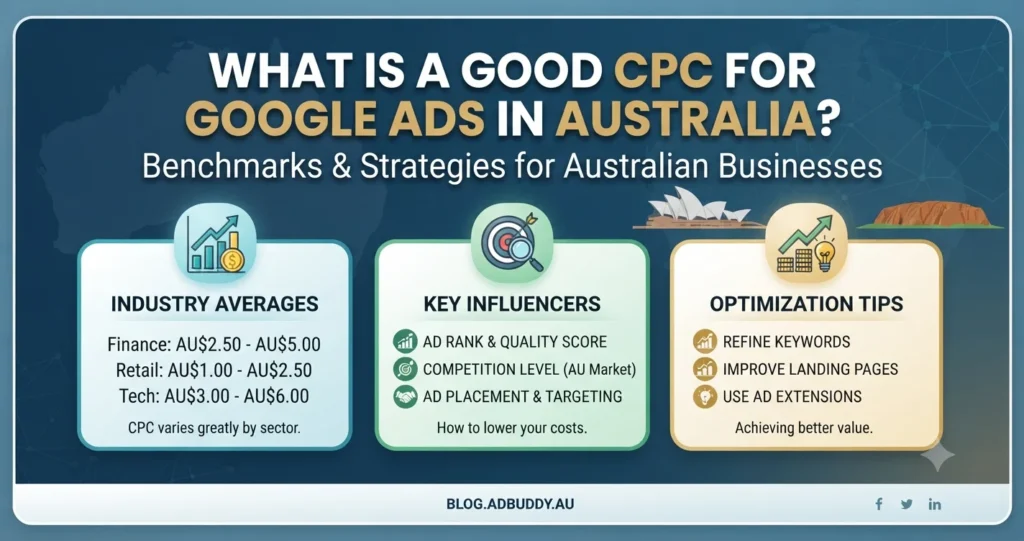
A good cost per click (CPC) for Google Ads in Australia is one that helps your business generate profitable leads or sales within your advertising budget. There is no universal ideal CPC because click prices vary by industry, keyword competition, location, search intent and conversion rate.
For example, an average CPC of A$3 may work well for one business, while another may profitably pay A$15 or more for a click that is likely to generate a valuable customer. These figures are illustrative examples, not verified Australian industry averages.
The important question is not simply how much you pay for a click. It is how much you can afford to pay to acquire a customer while maintaining a sustainable profit margin.
A Google Ads CPC Calculator can help you estimate click costs, compare budget scenarios and calculate the maximum CPC that fits your business goals. When combined with Google Keyword Planner and reliable conversion tracking, it becomes easier to decide whether your advertising costs are reasonable.
In this guide, we explain how to evaluate Google Ads CPC in Australia, calculate your ideal click cost, understand industry differences and improve campaign performance. We also explain how Scalvia’s Google Ads services may help businesses plan and manage paid search campaigns.
Quick Answer: What Is a Good Google Ads CPC in Australia?
A good Google Ads CPC in Australia is an average click cost that allows you to acquire qualified leads or customers at an affordable price. The right amount depends on your industry, profit margins, conversion rate and customer lifetime value.
Use this table as an illustration of how different CPC levels affect your traffic budget, not as a benchmark of actual Australian market prices.
| Average CPC | Clicks from A$500 | Clicks from A$1,000 |
|---|---|---|
| A$2 | 250 | 500 |
| A$3 | 166 | 333 |
| A$5 | 100 | 200 |
| A$10 | 50 | 100 |
| A$15 | 33 | 66 |
| A$20 | 25 | 50 |
Calculations assume the entire budget is spent at the stated average CPC. Figures are rounded down to whole clicks. Management fees and other expenses are excluded.
A lower CPC generally allows you to buy more clicks from the same budget. However, more clicks do not automatically mean more revenue. The quality of the traffic and the percentage of visitors who convert are equally important.
For current keyword-specific estimates, use Google Keyword Planner, which provides keyword research, search estimates and campaign forecasts.
1. What Is Google Ads Cost Per Click?
Cost per click, or CPC, is the amount an advertiser pays when someone clicks an advertisement under a cost-per-click pricing model.
Google Ads uses an auction to determine which ads can appear and where they appear. Your actual click cost depends on factors such as your bid, auction-time ad quality, competition, the context of the search and the expected impact of ad assets.
Google explains that actual CPC is often lower than the maximum CPC bid because advertisers generally pay the amount needed to clear relevant Ad Rank thresholds and compete successfully in the auction.
Average CPC vs maximum CPC
These two metrics are different.
- Average CPC: The average amount charged for each click during a reporting period.
- Maximum CPC bid: The maximum amount you are willing to bid for a click under a manual CPC bidding setup.
- Actual CPC: The amount you are charged for an individual click.
The formula for average CPC is:
Average CPC = Total click cost ÷ Total clicks
For example, if your campaign spends A$600 and receives 200 clicks:
A$600 ÷ 200 = A$3 average CPC.
You can find average CPC in the relevant Google Ads campaign reports. Google’s official Average CPC documentation explains the calculation and how the metric differs from your maximum bid.
2. What Factors Determine a Good CPC in Australia?
Several factors influence how much you may need to pay for clicks and whether that cost makes commercial sense.
Industry and keyword competition
Advertisers competing for commercially valuable searches may be willing to bid more for potential customers. For example, a business selling high-value professional services may be able to justify a higher click cost than a business selling low-margin products.
However, industry labels alone cannot establish a reliable CPC. Two keywords within the same industry may have different competition levels, search intent and conversion potential.
Search intent
Search intent describes what someone wants to achieve when they enter a query.
Consider these examples:
- “What is business insurance?” suggests an informational need.
- “Business insurance quote Australia” suggests a stronger interest in obtaining a quote.
- “Compare business insurance providers” suggests a potential purchase decision.
These searches can have different commercial value. A higher-intent keyword may justify a higher CPC if it attracts people who are more likely to become customers.
Geographic targeting
CPC estimates can differ depending on whether you target a specific suburb, a major city, a state or the entire Australian market.
A local business should focus on the areas it can serve profitably. A national business may have different opportunities and competition across regions.
Ad quality and landing-page experience
Google evaluates ad quality in the context of each search. Expected click-through rate, ad relevance and landing-page experience are important diagnostic components.
Better ad quality can support stronger advertising performance and may help reduce click costs. However, improving Quality Score does not guarantee a particular CPC.
Conversion rate and customer value
Your conversion rate determines how many clicks turn into enquiries, purchases or other valuable actions.
If your website converts a larger share of relevant visitors, you may be able to afford a higher CPC while maintaining the same cost per lead.
Customer value matters too. A business that earns substantial gross profit from repeat customers may have a different affordable acquisition cost from a business that relies on one-off, low-margin sales.
3. How to Calculate Your Ideal Google Ads CPC
Rather than relying on a generic industry benchmark, calculate the maximum CPC your business can afford.
A Google Ads CPC Calculator can help you model the relationship between budget, click cost, conversion rate and acquisition cost.
Step 1: Decide your target cost per lead
Suppose your Australian business wants to keep advertising costs at or below A$100 per qualified lead.
This is your target cost per lead, not your CPC.
Step 2: Estimate your conversion rate
Assume 5% of your advertising clicks become qualified leads.
That means approximately five out of every 100 clicks generate a lead.
Step 3: Calculate your target CPC
Use this formula:
Target CPC = Target cost per lead × Conversion rate
A$100 × 0.05 = A$5.
Under these assumptions, an average CPC of A$5 corresponds to an estimated cost per lead of A$100.
Step 4: Compare the estimate with keyword data
Research your target keywords in Google Keyword Planner and compare the available bid estimates and forecasts with your calculated target.
If the expected CPC is higher than A$5, consider whether you can improve the conversion rate, target more valuable searches or adjust your acceptable cost per lead.
Step 5: Validate your calculations using actual results
Once your campaign is running, replace your assumptions with measured performance.
For example, if your campaign spends A$1,000 and generates 20 qualified leads, your cost per lead is A$50.
A$1,000 ÷ 20 = A$50.
This actual cost per lead is more useful for evaluating profitability than CPC alone.
4. How to Check Australian CPC Estimates
Google Keyword Planner is a practical starting point for estimating search advertising costs before launching a campaign.
Google explains that Keyword Planner can provide keyword ideas, average monthly search estimates, bid information and performance forecasts. Its estimates depend on variables including bids, budgets, ad quality, location targeting and market conditions.
How to use Google Keyword Planner
- Sign in to your Google Ads account.
- Open Keyword Planner under the Tools section.
- Select “Discover new keywords” or “Get search volume and forecasts”.
- Enter the keywords relevant to your products or services.
- Set your target location to Australia or the specific Australian regions you serve.
- Review available search estimates, competition indicators, bid estimates and forecasts.
- Compare different keyword groups and budget assumptions.
Google may require you to complete account setup and provide billing information to access basic Keyword Planner features.
What should you look for?
| Metric | Why it matters |
|---|---|
| Average monthly searches | Helps assess potential search demand |
| Competition | Indicates advertiser competition for a keyword |
| Bid estimates | Provides directional information for planning |
| Forecast clicks | Estimates potential traffic under your plan |
| Forecast cost | Helps model potential advertising spend |
| Forecast average CPC | Helps estimate click costs where available |
Do not treat these estimates as guaranteed future prices. Keyword Planner uses historical information and forecasting assumptions, and actual campaign performance can differ.
Why you should avoid generic CPC benchmarks
Published CPC benchmarks may use different countries, industries, campaign types, time periods and measurement methods. A figure from a US-wide report, for example, may not represent what an Australian business should expect.
Use industry reports for broad context, but base your campaign decisions on current keyword estimates for your own locations and search terms.
5. How to Improve Your Google Ads CPC
If your CPC is too high for your business goals, investigate the causes before making major bidding changes.
Improve keyword targeting
Choose keywords that reflect the services you provide and the customers you want to attract.
Test specific, commercially relevant search terms and review your Search terms report to identify irrelevant queries. Add negative keywords where appropriate to reduce wasted spend.
Write more relevant ads
Make sure your ad directly addresses the user’s search. Include accurate service information, explain your value proposition and provide a clear next step.
Avoid sending users to a generic page if a more relevant service or product page is available.
Improve your landing page
A useful landing page should match the ad, work well on mobile devices and make it easy for visitors to enquire or buy.
Consider whether the page answers important questions, explains pricing or service details where appropriate and provides a straightforward conversion path.
Review your bidding strategy
Check whether your strategy prioritises clicks, conversions or conversion value. Choose the strategy that best matches your business objective and make sure conversion tracking is reliable before relying on conversion-based optimisation.
Do not reduce all bids simply because your CPC looks higher than an arbitrary benchmark.
Measure cost per lead and customer acquisition cost
Track the cost of valuable outcomes, not just the cost of traffic.
If CPC remains high but qualified leads are affordable and profitable, lowering CPC may not be your most important priority.
If CPC and cost per lead are both increasing, investigate targeting, conversion rate, keyword competition and campaign settings.
6. Is a High CPC Always Bad?
No. A high CPC can still be profitable if each click has a strong chance of generating a valuable customer.
Consider two hypothetical campaigns:
| Metric | Campaign A | Campaign B |
|---|---|---|
| Average CPC | A$3 | A$8 |
| Clicks | 200 | 200 |
| Advertising spend | A$600 | A$1,600 |
| Conversion rate | 2% | 8% |
| Estimated conversions | 4 | 16 |
| Cost per conversion | A$150 | A$100 |
Campaign B pays more per click but generates more conversions and a lower cost per conversion in this example.
The scenario is illustrative and assumes the conversion rates represent comparable, meaningful business outcomes. It does not predict actual campaign performance.
The lesson is simple: evaluate CPC alongside conversion rate, lead quality, customer value and profit margins.
When should you worry about a high CPC?
Investigate when:
- Your CPC is rising without a corresponding improvement in lead or sales quality.
- Your cost per conversion exceeds your business target.
- Your budget is exhausted before you generate enough meaningful results.
- Your search terms attract irrelevant visitors.
- Your gross profit cannot support your acquisition costs.
The goal is not necessarily to achieve the lowest CPC. It is to acquire the right customers at a sustainable cost.
7. Common CPC Calculation Mistakes
Avoid these mistakes when evaluating your Google Ads performance.
- Using an industry average as a fixed target: Your business economics and keyword intent may differ from the benchmark.
- Confusing CPC with cost per lead: A cheap click may not convert into a customer.
- Treating suggested bids as guaranteed prices: Google provides estimates, not fixed future click costs.
- Ignoring management fees: Total marketing expenses may exceed your Google Ads spend.
- Changing several settings at once: It becomes harder to determine which adjustment influenced performance.
- Ignoring lead quality: More enquiries do not necessarily mean more qualified prospects.
- Making decisions from too little data: Short-term fluctuations may not reflect a lasting performance trend.
Review your campaign over a suitable period, accounting for conversion delays and the amount of data available.
8. How Scalvia Can Help With Google Ads
Finding a good CPC involves more than comparing your click cost with a published benchmark. Businesses need to understand their keyword strategy, targeting, ad relevance, conversion tracking and the value of the customers they acquire.
For businesses looking for professional assistance, Scalvia provides Google Ads services that can be considered when planning, managing and optimising paid search campaigns.
Before engaging Scalvia, discuss your advertising budget, target locations, business objectives and acceptable cost per lead or sale. Ask how campaign performance will be measured, what optimisation work is included and how often reporting will take place.
A sensible starting point is to calculate your affordable CPC, research your target keywords and establish measurable campaign goals before launching ads.
Professional management may help improve campaign structure and optimisation, but no provider can guarantee a particular CPC or return on investment. Results depend on competition, campaign execution, customer behaviour and the quality of your offer.
Conclusion: Find a CPC That Works for Your Business
A good cost per click for Google Ads in Australia is not a fixed dollar amount. It is the click cost your business can afford while generating relevant traffic, qualified leads and profitable sales.
Start by researching your keywords with Google Keyword Planner. Use a Google Ads CPC Calculator to estimate clicks and calculate your target CPC from your conversion rate and acceptable cost per lead. Once your campaign is active, evaluate actual results rather than relying entirely on industry benchmarks.
Remember that a low CPC is not automatically a sign of success, and a high CPC is not always a problem. What matters is whether your advertising investment generates valuable business outcomes at a sustainable cost.
If you need professional support, Scalvia provides Google Ads services that you can evaluate against your budget, goals and campaign requirements.
The best CPC is the one that supports profitable, measurable growth for your business.
What is a good cost per click for Google Ads in Australia?
A good CPC is one that allows your business to generate profitable leads or sales. There is no universal Australian benchmark that applies to every industry, keyword or location. Use Google Keyword Planner and calculate your affordable CPC based on conversion rate and customer value.
What is the average Google Ads CPC in Australia?
There is no single average that accurately represents every Australian Google Ads campaign. CPC varies by industry, keyword, location, campaign type and time period. Use current Keyword Planner estimates for your target keywords rather than relying on an unrelated industry average.
How do I calculate my ideal Google Ads CPC?
Multiply your target cost per lead by your expected conversion rate. For example, a A$100 target cost per lead and a 5% conversion rate produce a target CPC of A$5 under this simplified model.
Is A$5 a good CPC for Google Ads?
A$5 may be suitable for one campaign and too expensive for another. If your website converts clicks efficiently and customers generate sufficient profit, it may be affordable. Compare it with your target acquisition cost and actual campaign results.
Why is my Google Ads CPC so high?
High CPC can result from competitive keywords, auction conditions, bidding decisions, ad relevance and other campaign factors. Review your keyword performance, search terms, landing-page experience and conversion data to identify the likely cause.